Primary passage: Genesis 10–11
Estimated time: 20–30 minutes
Suggested rhythm: Read Scripture 10–15 minutes; study the notes 5–7 minutes; answer the questions 5–8 minutes; pray for about 1 minute.
Study rule: Read the assigned Scripture before these notes. Scripture is the authority; summaries, connections, and applications below are study helps.
1. Read
Read Genesis 10–11. Notice the repeated words about families, languages, lands, and nations. Compare God’s command to fill the earth with Babel’s desire to avoid being scattered.
2. Plain-language summary
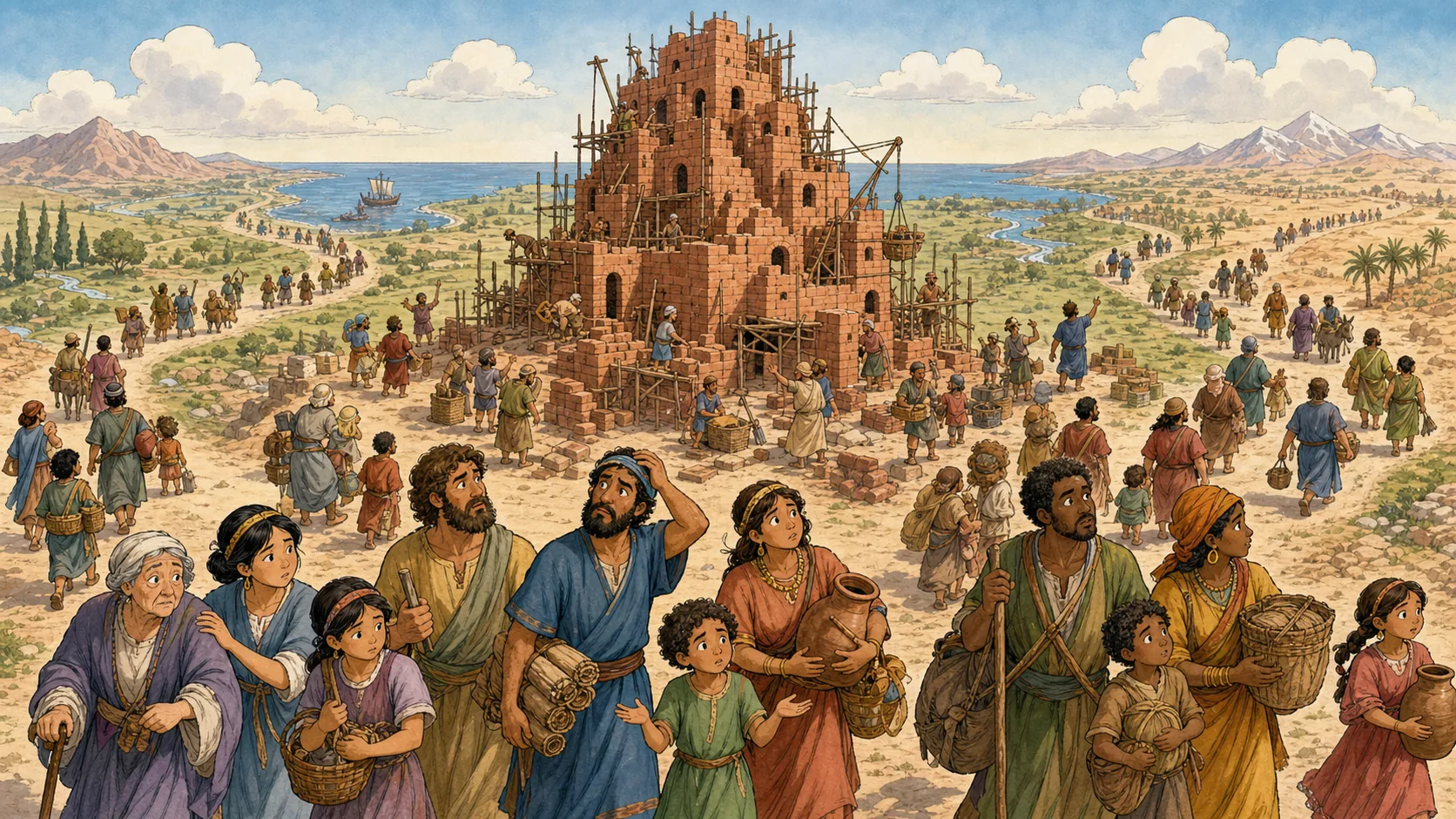
Genesis 10 presents the descendants of Noah’s sons spreading into clans, languages, lands, and nations. Genesis 11 then looks closely at a proud city-building project. The people use one language, build with fired bricks, seek a famous name, and try to avoid being scattered. God confuses their language and scatters them, stopping the project. A genealogy then narrows from Shem to Terah and introduces Abram, preparing for God’s answer of blessing in Genesis 12.
3. What does this show about God?
- God is Lord over every clan, language, land, and nation.
- God sees human projects clearly, including their motives.
- The builders seek to make a name for themselves and avoid being scattered. Read alongside God’s command to fill the earth, the story shows their project as self-exalting resistance to God’s purpose.
- God can restrain evil without destroying all humanity.
- God continues his purpose through the family line that leads to Abram.
4. Command, promise, warning, covenant
| Category | Observation | Reference |
|---|---|---|
| Command | The earlier command to fill the earth stands behind the story; Babel resists scattering. | Genesis 9:1, 7; 11:4 |
| Promise | No new promise is announced at Babel. The genealogy prepares for God’s promise to Abram in Genesis 12. | Genesis 11:10–32; 12:1–3 |
| Warning | Human unity is not automatically good; prideful cooperation against God ends in frustration and scattering. | Genesis 11:1–9 |
| Covenant | The Noahic covenant remains in effect, but no new covenant is made in Genesis 10–11. | Genesis 9:8–17 |
5. Important correction
Babel does not teach that ethnic diversity is a curse or that people of different nations must remain socially separated. The judgment concerns this self-exalting project. Scripture’s final vision gathers every nation and language in worship before God and the Lamb (Revelation 7:9).
6. Connect to Christ and the New Testament
- New Testament family-line connection: Matthew 1 and Luke 3 place Jesus within the family history that Genesis carries forward through Abraham.
- Canonical theme: At Pentecost, people from many nations hear God’s mighty works in their own languages (Acts 2:5–11). Acts 2 does not erase languages; God communicates the gospel across them. This is a fitting gospel answer to Babel’s divided pride, though Acts does not call it a simple cancellation of Babel.
- Future hope: Revelation 7:9 pictures a redeemed multitude from every nation, tribe, people, and language worshiping before God and the Lamb.
7. Vocabulary
- Nation: A people group described by shared descent, land, language, government, or culture.
- Clan: A large family group connected by shared ancestry.
- Scattered: Spread out in different directions or places.
- Babel: The city and tower associated with confused language and scattering.
- Pride: Acting as though we do not need God and seeking glory apart from him.
- Genealogy: A family record that traces descent.
- Pentecost: The event in Acts 2 when the Holy Spirit empowered witness to Jesus across languages.
8. Think and respond
- What reasons do the builders give for constructing their city and tower (Genesis 11:4)?
- What does God do in response to the project (Genesis 11:6–9)?
- Extension: Read Acts 2:5–11 and Revelation 7:9. How do these passages describe different languages and peoples?
9. Prayer
Lord of all nations, expose our pride and our hunger to make a name for ourselves. Teach us to use our work and cooperation for what is true and good. Gather people from every language around Jesus Christ, the Lamb and King. Amen.