
Scripture and interpretation boundary
The biblical record does not reveal many of Bathsheba’s private thoughts, conversations, motives, or daily experiences. This retelling therefore identifies imagined scenes and possibilities rather than presenting them as historical or biblical facts. Direct biblical speech is retained in modern punctuation; surrounding narration is interpretation and, where clearly identified, dramatic reconstruction.
Primary biblical passages: 2 Samuel 11–20; 1 Kings 1–3; 1 Chronicles 3:5, 22, and 28–29; Psalm 51; Matthew 1:6.
Authority boundary: Canonical Scripture is the primary authority. This narrative is a Scripture-aware retelling for study and accessibility, not inspired text.
Bathsheba’s story enters Scripture at a moment of terrible moral collapse. A king sees, desires, takes, conceals, and finally arranges the death of a faithful man. A woman loses her husband and is brought into the royal household carrying the king’s child. The account in 2 Samuel is brief, restrained, and devastating. It does not give us Bathsheba’s private thoughts, nor does it explain every choice she made. It tells us enough, however, to expose David’s abuse of royal power and to show how one hidden sin widened into deception and bloodshed.
This is the beginning of Bathsheba’s long passage through sorrow and palace life. Her later years will be bound to Solomon and the succession to David’s throne, but this part of the story ends before any triumph appears. It ends with Uriah dead, Bathsheba mourning, and David bringing her into his house. What may have looked honorable from the streets of Jerusalem was, in the sight of the Lord, profoundly evil.
Jerusalem in the Days of David
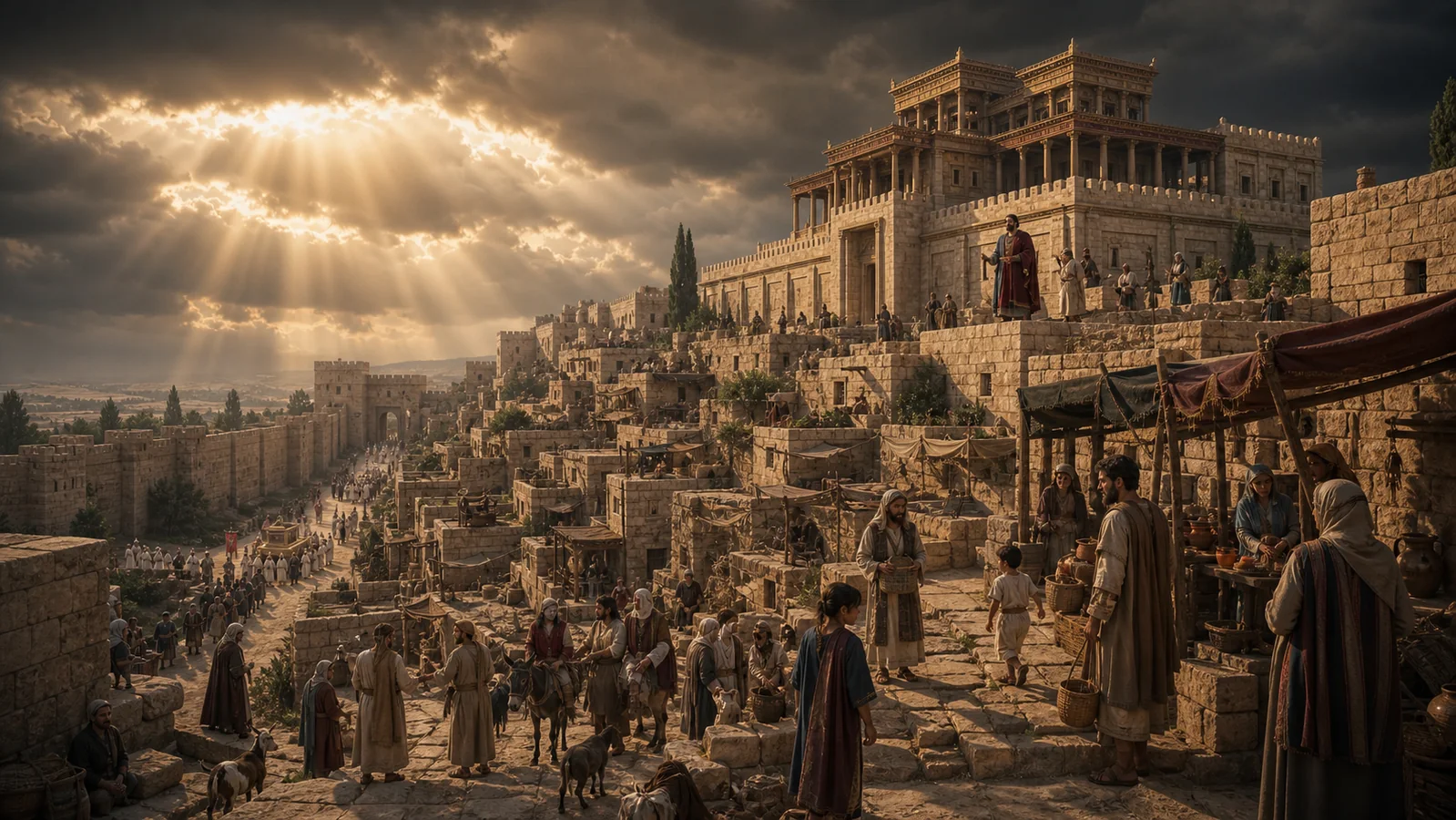
By this time David was no longer the young shepherd who had faced Goliath with a sling. He was no longer a fugitive hiding from Saul in caves and wilderness strongholds. He had become king over a united Israel, captured the Jebusite fortress of Zion, established Jerusalem as his capital, and brought the ark of the covenant into the city with public rejoicing.
The kingdom had grown strong under his rule. David’s armies had defeated surrounding enemies, and his authority extended far beyond the small territory he had first governed at Hebron. Jerusalem itself was changing from a captured hill fortress into the political and spiritual center of the nation. The city’s walls, gates, houses, courts, and royal buildings testified to a kingdom becoming established.
Yet strength on the outside did not mean peace within. David’s household was already complicated. He had taken several wives and had many sons. Scripture names Michal, Abigail, Ahinoam, Maacah, Haggith, Abital, and Eglah among the women connected to his household, and it records additional wives and concubines in Jerusalem. The consequences of that household disorder would become painfully visible in the years ahead. Amnon, Absalom, and Adonijah would each bring grief and conflict into David’s family.
At this point, however, those later disasters were still largely hidden. David sat securely on the throne. His soldiers fought under Joab. His court functioned, his servants answered his commands, and the people knew him as the Lord’s anointed king. He had received extraordinary mercy and favor from God. He had also been entrusted with extraordinary responsibility.
Bathsheba lived somewhere within reach of the palace. Second Samuel identifies her as “the daughter of Eliam” and “the wife of Uriah the Hittite.” Eliam and Uriah are both named in the list of David’s mighty men, though Scripture gives few details about Bathsheba’s home or her life before this event. Her family therefore had significant connections to David’s warriors. Eliam may also have been the son of Ahithophel, David’s counselor, if the Eliam named in the list of mighty men is the same man. The text does not pause to explain the relationship, so it is best not to build more upon it than the record allows.
Nor do the books of Chronicles describe Bathsheba’s early domestic virtues, religious habits, generosity, appearance in the streets, or private hopes. We may reasonably imagine that, like other women of her time, she took part in the daily work of a household—food preparation, water, cloth, servants, family obligations, and the observances of Israel—but Scripture does not give us those scenes. It leaves her early life largely hidden.
What Scripture does tell us is enough to establish three crucial facts: Bathsheba was married; her husband was away with David’s army; and David knew exactly whose wife she was before he sent for her.
A King Under God’s Command
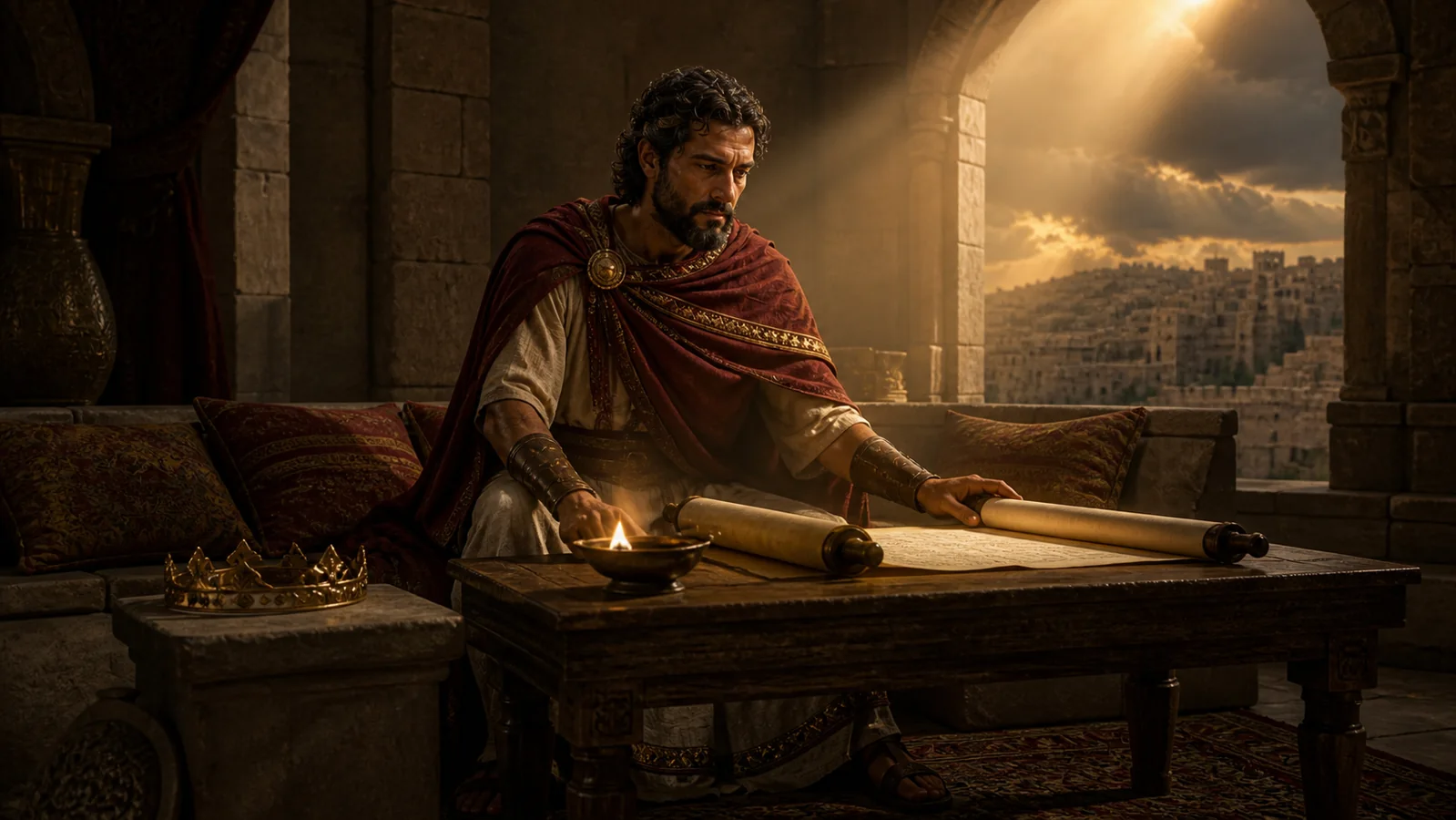
David’s past makes the coming offense more grievous, not less. He knew what it was to be vulnerable before a powerful ruler. Saul had used soldiers, servants, and royal authority to pursue him. David had spent years living with the consequences of a king’s jealous desire. On more than one occasion, when Saul came within his power, David refused to seize the throne through violence. He had once shown remarkable restraint because he believed the kingdom belonged to the Lord.
He also knew that Israel’s king was not an absolute ruler who could define good and evil for himself. The law of Moses placed the king under God’s Word. Deuteronomy warned that a king must not multiply wives for himself, lest his heart turn away, and required him to read the law so that he would not lift his heart above his brothers. David’s palace stood high over Jerusalem, but the king himself remained beneath the authority of God.
God had made a covenant with David and promised to establish his house. That promise was an act of grace, not a shield for wrongdoing. The future of David’s line did not depend on his ability to protect his reputation by any means necessary. Had he trusted the Lord, he could have told the truth and submitted to God’s judgment. Instead, he acted as though the survival of his name and throne depended upon concealment.
This tension is important because David was not simply a stock villain. Scripture remembers him as a man after God’s own heart, records his faith, and preserves songs in which he worshiped the Lord with sincerity. Yet the Bible does not use those truths to excuse him. A person may have known real grace, exercised genuine faith, and still commit dreadful evil when desire is welcomed and power is turned toward self-protection. David’s former faithfulness did not make this episode less serious. It made his knowledge and responsibility clearer.
The narrative is also careful about where it directs our eyes. Bathsheba’s beauty is stated in one sentence; David’s decisions fill the rest of the chapter. Beauty did not compel the king to inquire. The first look did not force him to summon. The summons did not force him to conceal. At every stage, David acted. The story concerns temptation, but even more, it concerns what a powerful man chose to do after temptation came.
The Season When Kings Went to War

The account opens with an important contrast:
In the spring of the year, the time when kings go out to battle, David sent Joab, and his servants with him, and all Israel. And they ravaged the Ammonites and besieged Rabbah. But David remained at Jerusalem.
Israel was at war with the Ammonites. Joab and the army had gone to besiege Rabbah, but David stayed behind. The text does not explicitly say that remaining in Jerusalem was itself a sin. Nevertheless, the sentence places the king at home while his soldiers faced danger in the field, and everything that follows grows out of what he did there.
One late afternoon David rose from his couch and walked on the roof of the king’s house. From that elevated place he saw a woman bathing. Second Samuel says plainly that the woman was very beautiful. It does not say that she intended to be seen. It does not describe her bathing as an act of seduction. Later in the verse, the writer explains that she had been purifying herself from her uncleanness. The scene should therefore not be embellished into a deliberate attempt to attract the king.
David saw her and made an inquiry. A servant answered with a question that should have stopped him: “Is not this Bathsheba, the daughter of Eliam, the wife of Uriah the Hittite?”
The answer placed boundaries around her identity. She was not an unnamed woman available for royal pleasure. She was Bathsheba. She was Eliam’s daughter. She was Uriah’s wife. Her husband was one of the men risking his life in the king’s service.
David knew Uriah. The Hittite was counted among his mighty men, the band of proven warriors whose courage and loyalty helped secure David’s kingdom. The designation “Hittite” marked Uriah’s foreign background, yet his name invokes the God of Israel, and his later words show deep concern for the ark, Israel, Judah, Joab, and the soldiers in the field. Whatever his origins, he had bound his life to David’s people and David’s cause.
The servant’s reply gave David every reason to turn away. The law of God already gave the command: “You shall not commit adultery,” and, “You shall not covet your neighbor’s wife.” David was not ignorant of those words. He was Israel’s king, responsible to live under the covenant rather than above it.
But David did not turn away.
The King Sent and Took
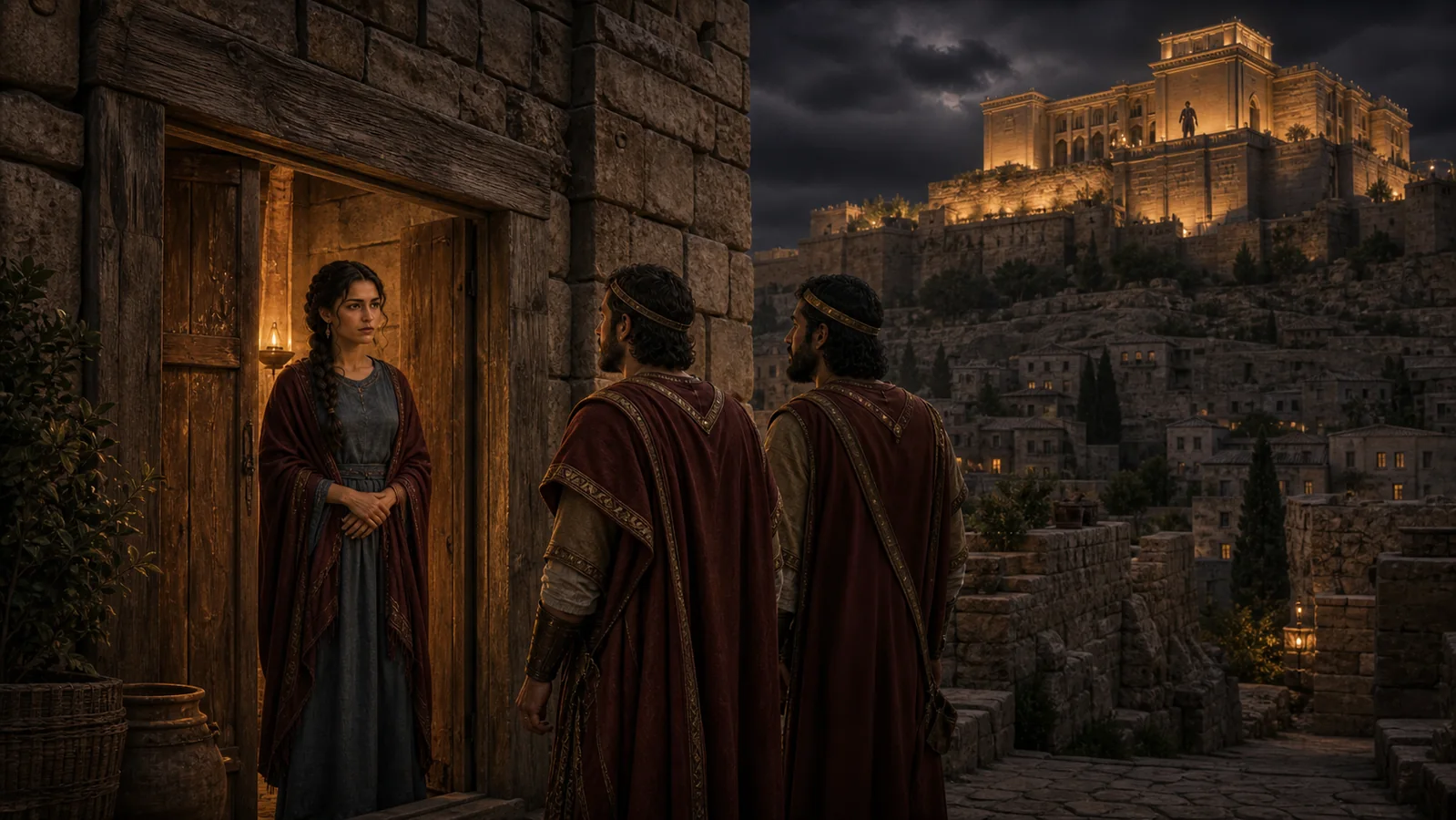
Second Samuel tells the next events with chilling economy: David sent messengers and took Bathsheba; she came to him; he lay with her; after purifying herself, she returned to her house.
The passage does not record a courtship. It gives no conversation between them and no account of Bathsheba’s feelings as the messengers arrived. It does not say that David threatened her, and it does not say that she welcomed the summons. It does not settle every question modern readers may ask about her willingness or resistance.
It does make the imbalance of power impossible to ignore. David was the king. Bathsheba was his subject and the wife of one of his soldiers. David sent multiple messengers, and the verbs of the account place the initiative with him: he saw, he inquired, he sent, and he took. We should not invent resistance that the text does not report, but neither should we describe Bathsheba as though she approached David freely as an equal or “gave herself without hesitation.” Scripture does not say that.
A royal command carried enormous weight. Bathsheba was summoned into the center of David’s authority while her husband was away fighting David’s war. Whatever passed through her mind, the text does not tell us. Her silence must not be filled with confident accusations against her, romantic language about mutual desire, or claims that she trusted the king. The inspired account concentrates moral responsibility on David’s actions.
Afterward, Bathsheba returned to her house. That short statement closes the encounter without softening it. No tender farewell is reported. No promise from David is mentioned. The king remained in his palace, and Bathsheba went home alone.
We may imagine the walk back through Jerusalem and the heaviness of returning to familiar rooms after such an event, but that is imaginative reconstruction, not recorded history. We do not know whether she wept, prayed, felt numb, feared discovery, blamed herself, or wondered what David would do next. Any of those reactions might be humanly understandable, but none is stated in the passage.
The text gives one detail about her purification to establish the timing: Bathsheba had recently completed the ritual cleansing connected with menstruation. This makes the pregnancy that followed attributable to David rather than Uriah. The narrator is not inviting speculation. He is quietly closing the door on David’s future attempt to hide the child’s paternity.
The Silence Around Bathsheba

Bathsheba’s limited speech in this chapter has often invited readers to construct a personality for her. Some retellings make her calculating and ambitious from the beginning. Others make her a willing seductress, a helpless victim without any agency, or a secret lover joined to David by mutual passion. None of those full portraits comes from 2 Samuel 11.
Her silence does not prove consent, and it does not prove that she verbally resisted. It tells us that the narrator has not given us her side of the encounter in direct speech. That limitation should produce humility. Where Scripture does not disclose her motives, a responsible retelling may describe possibilities, but it must not convert a possibility into an accusation.
We may imagine that a summons from the palace interrupted an otherwise ordinary day. We may imagine uncertainty as royal messengers waited, or fear about why the king wanted her. We may also imagine the difficulty of returning home while Uriah remained at the siege. These scenes help a reader feel the human weight of the narrative, but they remain imagined. We cannot quote thoughts Bathsheba never speaks or say that we know how she understood David’s command.
The same care is needed when speaking about responsibility. The text gives no divine approval to what occurred. David committed adultery with another man’s wife, and later Nathan would confront him as the one who had taken Uriah’s wife. Bathsheba participated in the event in the basic sense that she was present, but the narrative does not apportion blame equally or pause to charge her. It traces the royal initiative and will direct the prophetic rebuke toward David.
It is therefore misleading to describe Bathsheba at this stage as making “strategic moves.” Her one clear action after the encounter was to send David the truth about her pregnancy. She neither designed David’s cover-up nor asked him to summon Uriah. She did not write the death order, arrange the battle, or bring herself into the royal household. Those were David’s decisions.
Later, after years in the palace, Bathsheba will speak and act in the struggle over Solomon’s succession. That later woman should not be projected backward into this first scene as though she had already planned a path to the throne. People grow, circumstances change, and biblical narratives unfold over time. At the beginning of her recorded story, Bathsheba is caught in events set in motion by the king.
“I Am Pregnant”
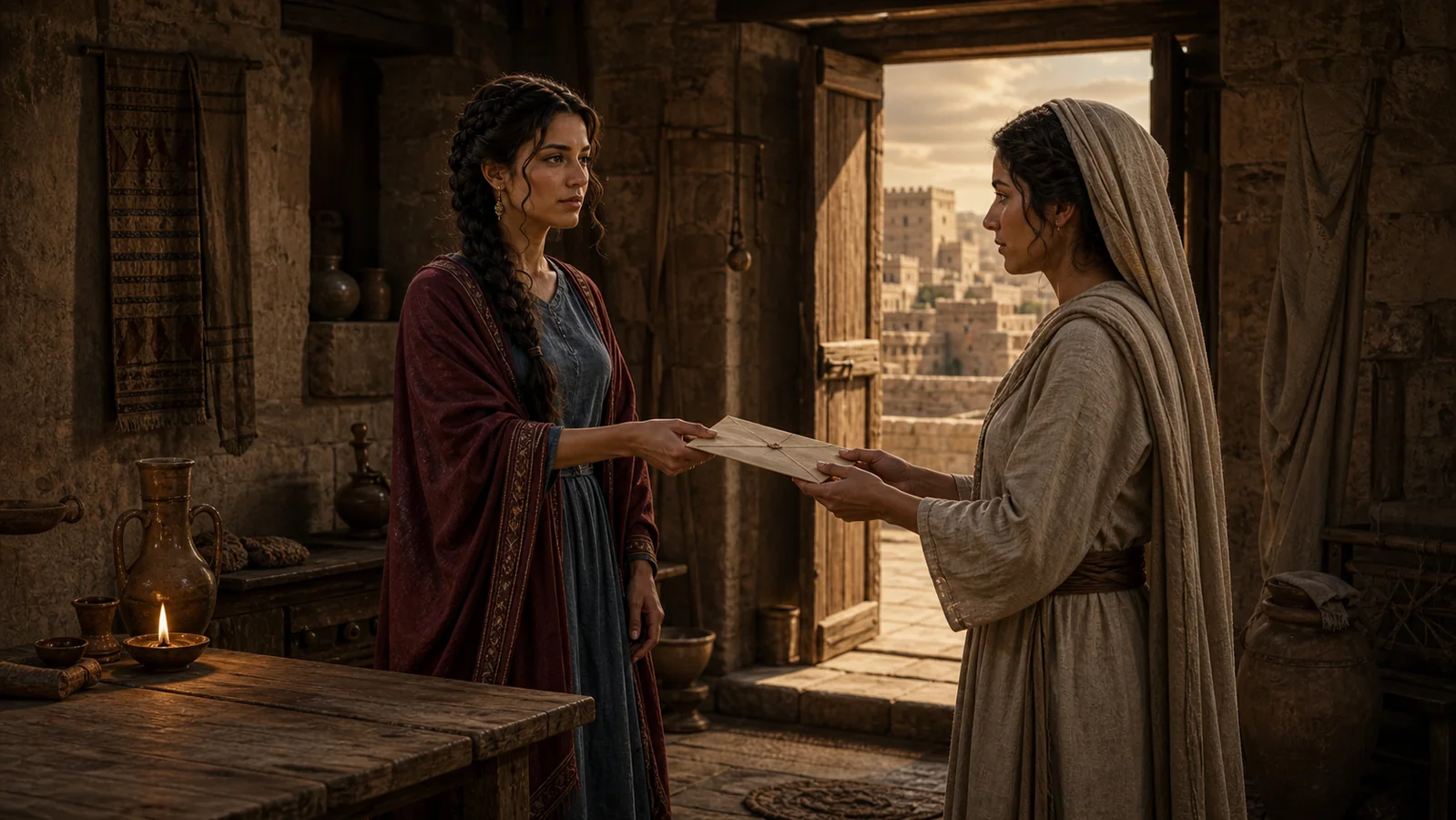
Some time later Bathsheba realized that she had conceived. Scripture does not list symptoms, count the passing weeks, or describe the moment of discovery. It simply says, “And the woman conceived, and she sent and told David, ‘I am pregnant.’”
Those three words changed the situation completely.
Until then, David might have imagined that the event could remain hidden. Bathsheba had returned home, Uriah was still at war, and the palace had resumed its routine. A pregnancy made secrecy temporary. Uriah had been absent. When the child’s birth drew near, the timing would raise questions. Bathsheba’s message put the consequences of David’s act before him.
The text does not say that Bathsheba wrote a letter, sent a piece of cloth, or explained her fears. It does not tell us that she begged David for protection. Her entire recorded message is direct: “I am pregnant.” She communicated the fact to the man responsible and left him to answer it.
David could have confessed. He could have humbled himself before the Lord, acknowledged his sin against Uriah and Bathsheba, and accepted the public consequences. Nothing in the account suggests that confession would have been easy, but righteousness does not become optional when obedience is costly.
Instead, David began to conceal what he had done.
His first plan depended on Uriah. If the soldier could be brought home and induced to sleep with Bathsheba, people might assume that the child was his. David therefore sent word to Joab: “Send me Uriah the Hittite.” Joab obeyed, and Uriah returned from the siege to Jerusalem.
The order probably appeared routine. A king could summon a soldier to report on a military campaign. Uriah had no stated reason to suspect that David’s concern was not the war at all, but the child growing in his wife’s womb.
Uriah Before the King

When Uriah came to the palace, David asked about Joab, the soldiers, and the progress of the war. The questions sounded like the concerns of a commander receiving a report from the front. Yet the narrative shows that David’s true purpose was personal. He wanted Uriah to go home.
After the report David said, “Go down to your house and wash your feet.” In that setting, washing one’s feet could be part of settling into the comfort of home after travel. David expected Uriah to eat, rest, and be reunited with his wife. The king even sent a gift of food after him.
But Uriah did not go home.
He slept at the entrance of the king’s house with the servants of his lord. When David heard it, he questioned him: “Have you not come from a journey? Why did you not go down to your house?”
Uriah’s answer exposed the contrast between the soldier and the king:
The ark and Israel and Judah dwell in booths, and my lord Joab and the servants of my lord are camping in the open field. Shall I then go to my house, to eat and to drink and to lie with my wife? As you live, and as your soul lives, I will not do this thing.
Uriah would not enjoy domestic comfort while the ark, the nation, his commander, and his fellow soldiers remained in the field. His words may reflect a wartime practice of abstinence as well as personal solidarity with the army. Whatever the full background, his resolve was clear. He refused to take for himself what his companions could not enjoy.
The irony is painful. Uriah denied himself the lawful comfort of his own home out of loyalty to David’s campaign. David, who had remained in Jerusalem, had taken Uriah’s wife while Uriah fought for him.
We are not told whether Uriah suspected anything. Some readers have wondered if his refusal concealed knowledge of David’s act, but the passage never says so. It presents his conduct as honorable and unwavering. We should therefore resist turning him into a silent investigator when the text depicts him as a faithful soldier.
David told Uriah to remain in Jerusalem another day and promised to send him back afterward. The delay gave David a second opportunity to carry out the deception.
A Second Attempt at Concealment
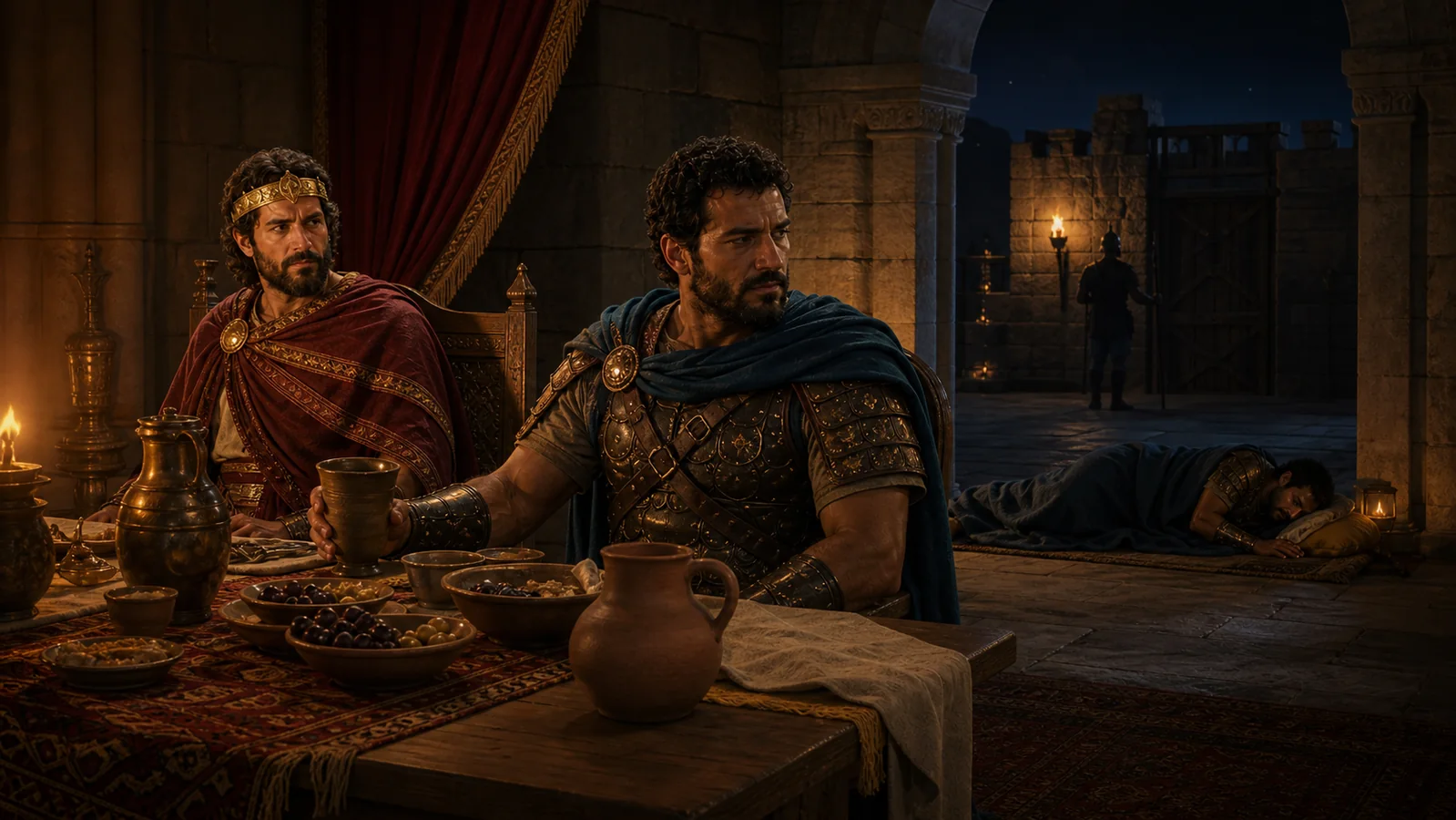
The next day David invited Uriah to eat and drink in his presence. This was not simply royal hospitality. David made him drunk, apparently hoping that wine would weaken the discipline that had kept him from Bathsheba’s house.
Even then Uriah did not go home.
That evening he lay on a couch with the king’s servants, and the narrator repeats the essential fact: “He did not go down to his house.” David’s plan had failed twice—first against Uriah’s sober resolve and then against the same resolve under the influence of wine.
David was now confronted with a choice. He could stop. He could tell the truth. He could recognize in Uriah’s faithfulness a rebuke to his own conduct. Instead, his concealment became more ruthless.
Sin had already moved through a terrible sequence. David’s gaze became coveting. Coveting became taking. Taking resulted in pregnancy. Pregnancy produced deceit. When deceit failed, David turned toward murder.
The change was not sudden in the sense of being disconnected from what came before. Each refusal to repent made the next evil easier to consider. David had begun by treating Bathsheba as someone he could take. He would now treat Uriah as someone he could remove.
The Letter in Uriah’s Hand

In the morning David wrote a letter to Joab and sent it by Uriah. The faithful soldier carried the order for his own death.
David’s command was explicit: “Set Uriah in the forefront of the hardest fighting, and then draw back from him, that he may be struck down, and die.” This was not an unfortunate battlefield decision that happened to cost Uriah his life. David intended the outcome. He used military authority and the confusion of battle to make a planned killing look like an ordinary casualty of war.
The account does not describe Uriah’s ride back to Rabbah, what he thought the sealed letter contained, or what he said when he handed it to Joab. We may imagine him carrying it as a trusted royal message, but Scripture gives no scene in the general’s tent and no private conversation between the two men. Dramatic details about Joab reading the letter twice, hiding his reaction, or reflecting on the moral cost of command go beyond the text.
What we know is that Joab received the order and acted upon it.
Joab was an experienced commander. As he watched the city, he placed Uriah where he knew valiant enemy soldiers would be. The operation did not unfold exactly as a simple withdrawal of support from one isolated man. Israel’s forces went close to the wall, the men of the city came out and fought, and several of David’s servants fell. Uriah the Hittite died among them.
David’s command therefore cost more than one life. Other soldiers were killed in the action arranged to eliminate Uriah. They were not named in the narrative, but their deaths mattered. David’s attempt to hide one sin multiplied bloodshed beyond the man he had targeted.
Joab’s role also matters. David was the author of the order, but Joab chose to obey it. He did not protest, expose the plot, or refuse to use the army as an instrument of private murder. The general adapted the command to the conditions around Rabbah and sent men into a position where he knew the enemy’s strongest fighters would be found. Royal power supplied the command; military power carried it out.
The machinery of the kingdom that should have defended Israel was thus turned against one of Israel’s own faithful soldiers. A sealed letter, a commander’s placement of troops, and an official report transformed personal sin into institutional violence. Uriah’s death could be entered among the losses of war even though it had been deliberately sought in the palace.
That concealment helps explain the severity of the chapter. David did not kill Uriah in a public rage. He constructed distance between his intention and Uriah’s death. The Ammonites would strike the blows. Joab would arrange the position. The battlefield would supply a plausible explanation. Yet distance did not remove guilt. David’s hands did not have to hold the weapon for him to bear responsibility for the bloodshed.
Uriah, meanwhile, remained loyal to the end of the account. He carried David’s message without opening it and returned to his duty. Scripture does not tell us whether he had children, what hopes he held for life after the siege, or how long he and Bathsheba had been married. It gives him honor through what he does reveal: concern for the ark and the people, solidarity with his brothers in arms, obedience to command, and refusal to take comfort while others endured hardship.
The text does not describe Uriah fighting alone like a lion, raising his sword in a final charge, or choosing not to retreat. Such a death scene may sound heroic, but it is not reported. Scripture’s restraint is more severe: Joab placed him in danger; enemy fighters came out; some of David’s men fell; and Uriah died.
A loyal soldier had been betrayed by the king he served.
Joab’s Report
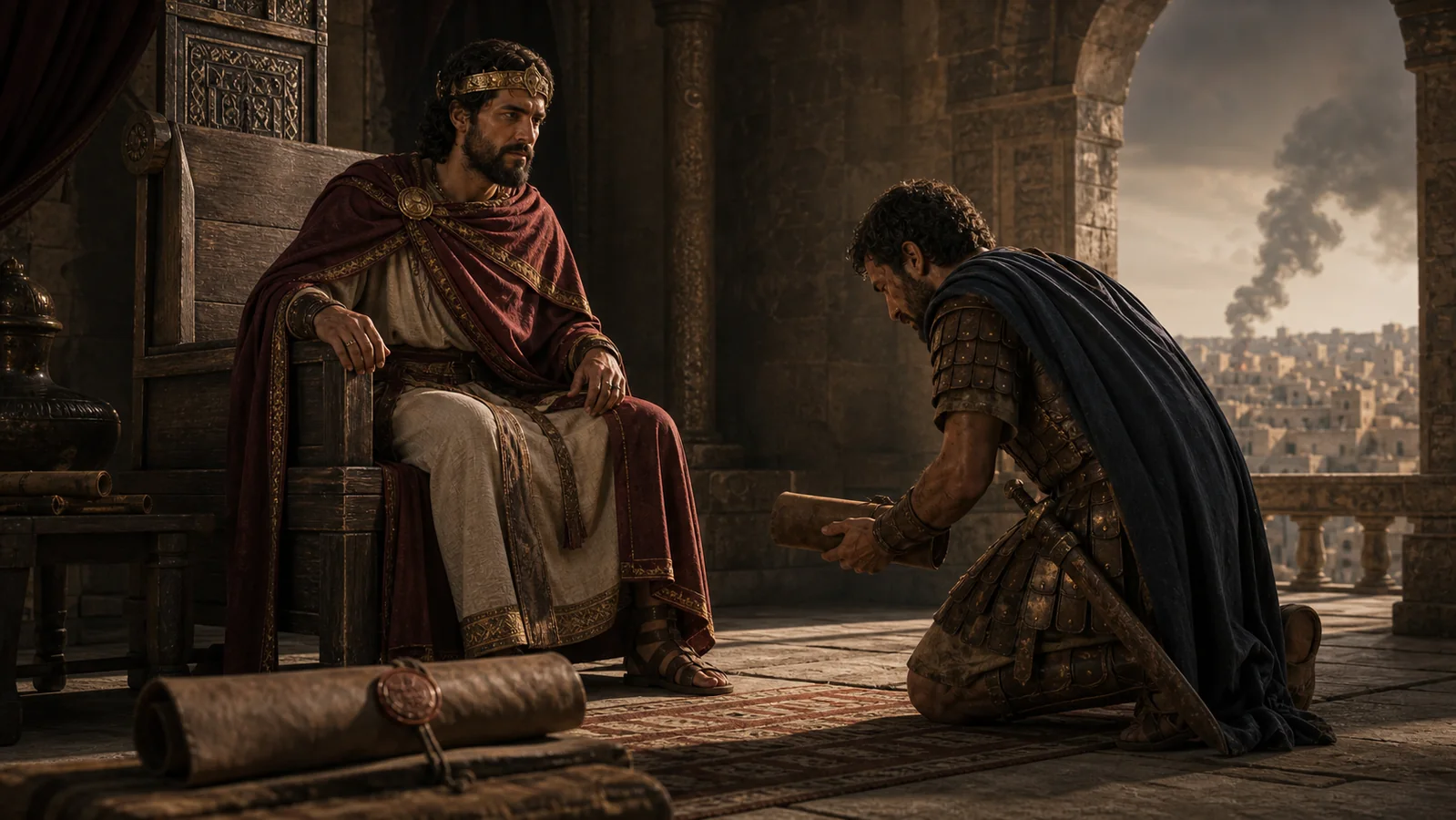
After the battle Joab sent a messenger to David with a report. He anticipated that the king might become angry when he heard that the troops had gone so near the city wall. The danger was well known. Joab reminded the messenger of Abimelech, who had died when a woman threw an upper millstone from the wall at Thebez. If David objected to the reckless approach, the messenger was to add, “Your servant Uriah the Hittite is dead also.”
Joab’s instructions show that he understood what information mattered most to David. The death of Uriah was not a regrettable detail buried among military losses. It was the message within the message.
The messenger came to Jerusalem and told David what had happened. He reported that the enemy had been stronger than expected, that they came out against Israel in the field, and that the Israelite forces drove them back toward the gate. Then archers shot from the wall, some of the king’s servants died, and the messenger delivered the crucial sentence: “Your servant Uriah the Hittite is dead also.”
David did not react with the outrage that Joab had feared. He sent back an answer designed to calm the general:
Thus shall you say to Joab, “Do not let this matter displease you, for the sword devours now one and now another. Strengthen your attack against the city and overthrow it.”
On the surface, David spoke as a seasoned king accepting the unavoidable losses of war. “The sword devours now one and now another” made Uriah’s death sound random, one more casualty among many. But David knew it was not random. He had written the order that directed the sword toward Uriah.
The words also concealed the deaths of the other soldiers used in David’s plan. He treated their loss as the ordinary appetite of battle, though his own deception had helped place them in danger. His reassurance to Joab was not pastoral comfort or honest military judgment. It was the response of a man whose immediate problem had been removed.
We should not claim that David showed no inward emotion, because the text does not describe his private reaction. He may have felt fear, relief, guilt, or some mixture of all three. What Scripture does record is his outward message, and that message contains no grief for Uriah, no confession, and no acknowledgment of his own responsibility.
Uriah was dead. David may have believed the path to concealment was finally open.
Bathsheba Mourns

When Bathsheba heard that her husband was dead, she mourned for him.
The statement is simple and deserves to be taken seriously. The text does not call her grief false, ceremonial only, or divided between sorrow and relief. It says she lamented for her husband. We do not need to invent speeches, tears, clothing, neighbors’ condolences, or the exact length and rituals of mourning in order to honor what is written.
Bathsheba had now lost Uriah after being summoned by the king and becoming pregnant by him. Whether she knew that David had arranged her husband’s death is not stated. She may have heard only that Uriah fell during the siege. The account does not say that servants told her about a royal letter, that palace watchers assembled the clues, or that rumors spread through Jerusalem. Those possibilities belong to speculation, not to the biblical narrative.
Nor does Scripture tell us that Uriah returned to his house or saw Bathsheba during his brief stay in Jerusalem. In fact, it repeatedly emphasizes that he did not go down to his house. Bathsheba may have learned that he was in the city, but even that is not explicitly reported. A dramatic retelling should not place her on a rooftop watching him ride away or portray a final meeting the text denies.
We are left with the stark facts: Uriah came home but would not take the comforts of home; David sent him back carrying his death order; Joab placed him in danger; he was killed; and Bathsheba mourned her husband.
Her lament stands at the end of one life and before the beginning of another. She was a widow, pregnant with David’s child, and still living under the shadow of royal power. The text does not reveal what future she expected. It does not say that she planned a strategic move, sought a place in the palace, or calculated how the pregnancy might advance her. Those themes may become relevant much later when she acts to secure Solomon’s succession, but they do not belong in this part of the story.
At this stage, Bathsheba is not presented as the architect of events. David is.
Brought into the King’s House
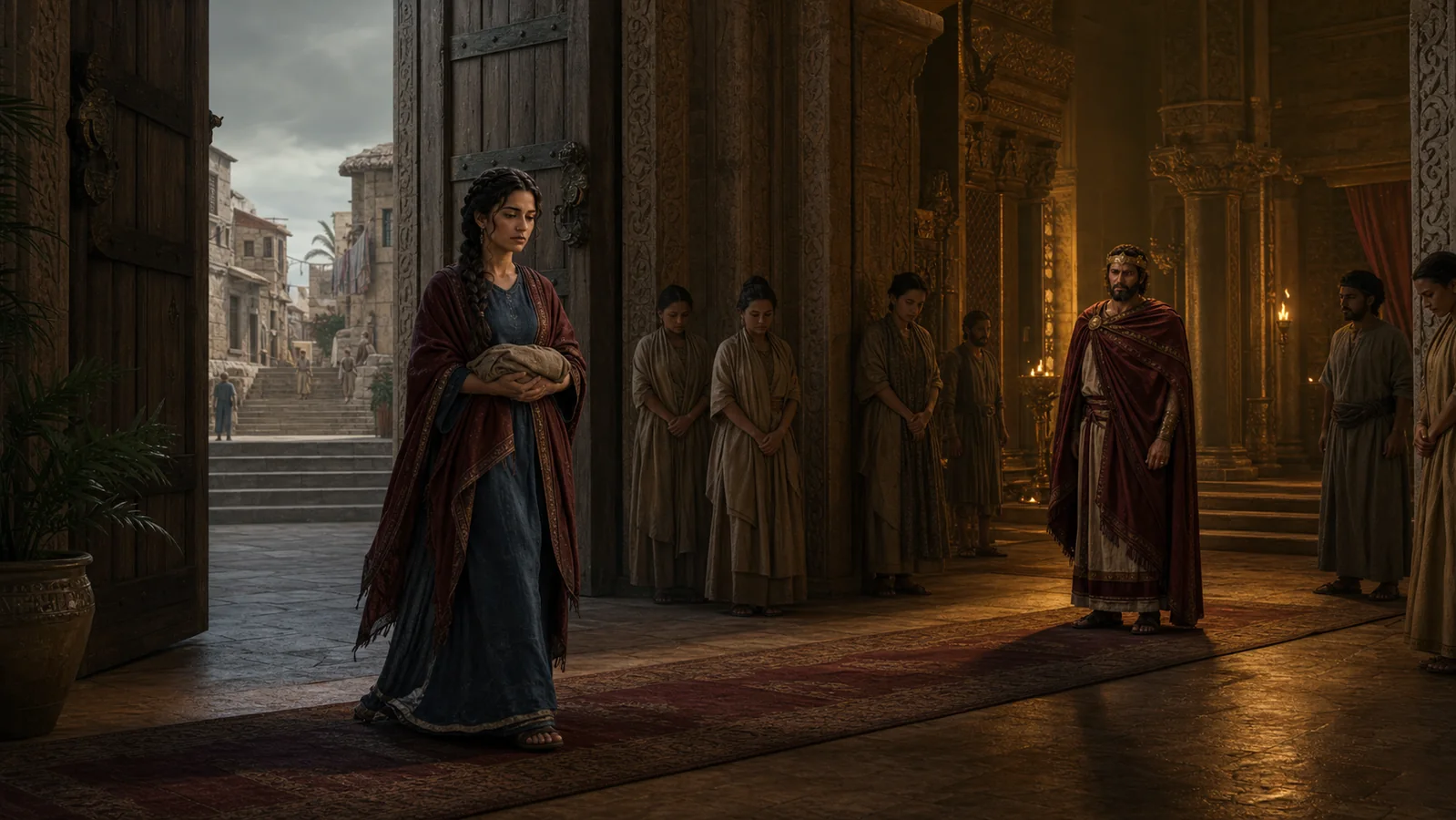
When the period of mourning was over, David sent for Bathsheba and brought her to his house. She became his wife and bore him a son.
The marriage could appear publicly generous. A king had taken the widow of a fallen warrior into his household and provided for her. The child would now be born under David’s roof. From a distance, the arrangement might have looked like a new beginning after wartime loss.
But the narrator will not allow appearances to become truth.
David had seen another man’s wife and taken her. When she conceived, he tried to make her husband appear to be the father. When Uriah’s honor frustrated the deception, David arranged his death. After Bathsheba mourned, David took her as his own wife. Marriage did not erase adultery, and royal provision did not erase murder.
Second Samuel closes this part of the account with the judgment that controls everything to come:
But the thing that David had done displeased the Lord.
That sentence names David as the responsible actor: “the thing that David had done.” The palace may have been quiet. The king’s plan may have fooled observers. Uriah could no longer speak, and Bathsheba had been absorbed into the royal household. Yet nothing was hidden from God.
David was still the Lord’s anointed king, but anointing did not make him morally untouchable. God’s covenant favor was not permission to despise God’s commandments. David’s authority remained accountable to the Lord who had given it.
Bathsheba’s entrance into the palace therefore cannot be told as an uncomplicated rise from an ordinary home to royal honor. It came through exploitation, bereavement, and a concealed killing. Nor should it be romanticized as the fulfillment of a secret bond between her and David. The text gives no such love story. It presents a chain of actions driven by David’s desire and sustained by his power.
At the same time, Bathsheba should not be reduced to a symbol or treated only as the object of David’s sin. She was a real woman: Eliam’s daughter, Uriah’s wife, a mourner, and now a mother within David’s house. Scripture does not yet give us her voice beyond the message, “I am pregnant,” but her later actions will show that this painful beginning was not the end of her story.
For now, however, the narrative pauses in darkness. Uriah is dead. Other soldiers have died with him. Bathsheba has finished mourning and entered the palace. David’s secret appears secure.
But the Lord has seen, and the Lord is not silent forever.
The Widow in the Palace
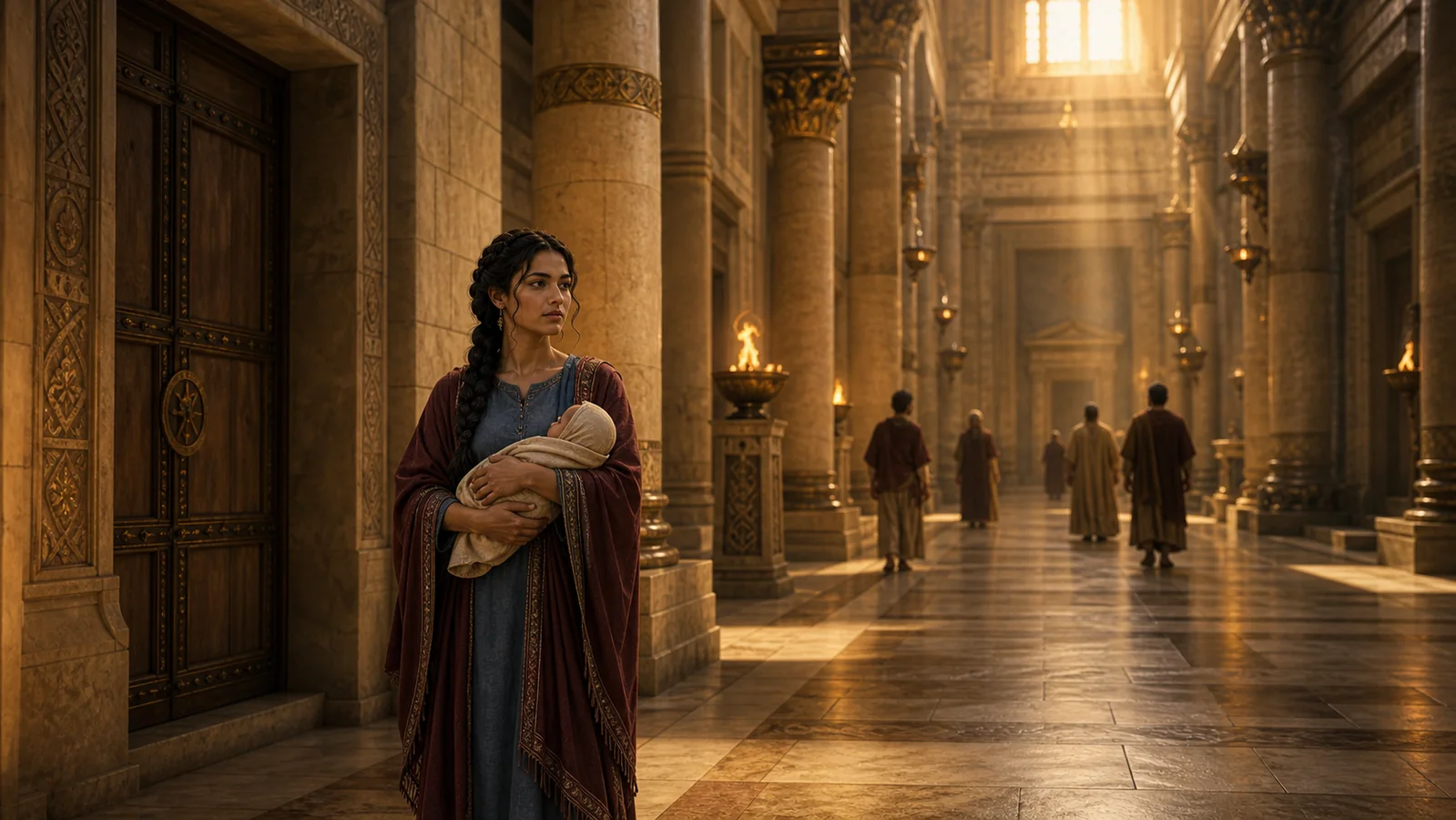
And now the widow was in the palace.
Bathsheba had mourned Uriah, and when the prescribed time of mourning had passed, David brought her into his house. She became his wife and bore him a son. Those are the plain facts recorded in Scripture. The text does not describe her first days at court, the reactions of David’s servants, or the reception she received from his other wives. We may imagine that such a sudden change—from a soldier’s household to the royal palace—required difficult adjustments, but Scripture leaves those private experiences unspoken.
The outward crisis appeared to have passed. Uriah was dead. Bathsheba was now lawfully counted among David’s wives. The child had been born under the protection of the king’s house. What David had done in secret seemed to have been covered by royal authority and the passage of time.
But it had not been hidden from the Lord.
The final sentence of 2 Samuel 11 changes the entire scene: “But the thing that David had done displeased the Lord.” Human voices may have remained quiet, but heaven had not mistaken silence for innocence. David was still the Lord’s anointed king, yet neither his calling nor his former faithfulness placed him above God’s command. He had taken Uriah’s wife, tried to conceal the resulting pregnancy, and arranged for Uriah to die by the sword of the Ammonites. The Lord saw the whole chain of sin.
Bathsheba’s thoughts during this period are not recorded. The text does not tell us whether she knew how Uriah had been placed in the fiercest fighting, whether she had heard suspicions about David’s orders, or whether she understood the danger hanging over the royal house. A dramatic retelling may picture her holding her infant with both hope and fear, but we should not confuse that picture with the biblical report. What Scripture does tell us is that the Lord sent Nathan the prophet to David.
Nathan’s Parable
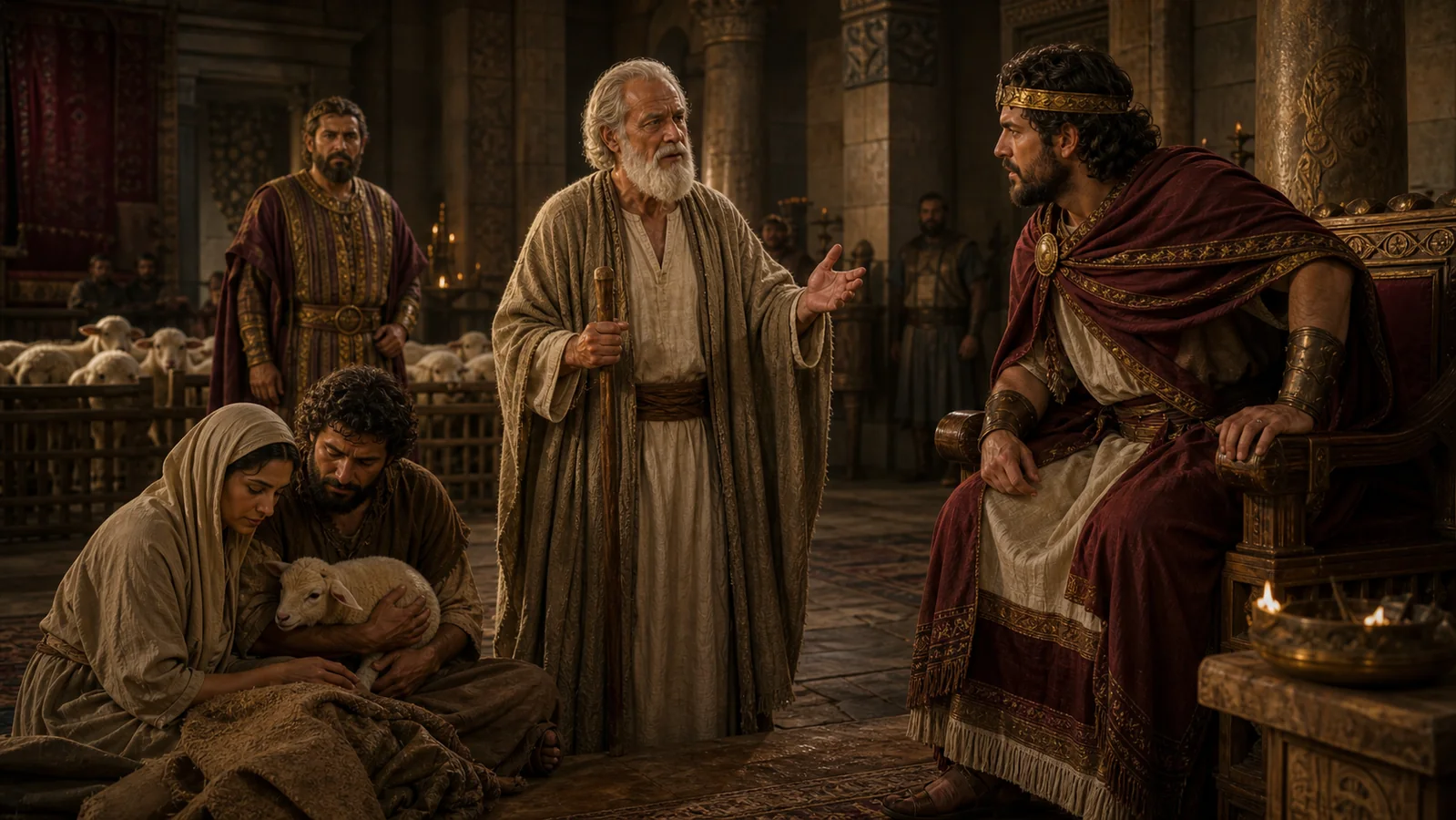
Nathan came to the king with a story.
“There were two men in one city,” he said, “one rich and the other poor.” The rich man possessed very many flocks and herds. The poor man had nothing except one little ewe lamb that he had bought. He raised it, and it grew up with him and his children. It ate from his food, drank from his cup, and lay in his arms. It was like a daughter to him.
Then a traveler came to the rich man. Rather than take an animal from his own abundant flocks, the rich man seized the poor man’s single lamb and prepared it for his guest.
Nathan’s parable was simple, but it placed David in the position of a judge. David had spent years defending the vulnerable and administering justice. He immediately recognized the rich man’s cruelty. His anger burned, and he declared that, as surely as the Lord lived, the offender deserved to die. He also said that the man must repay the lamb fourfold because he had done this thing and had shown no pity.
Then Nathan answered with the words that stripped away every disguise:
“You are the man.”
The prophet was not offering David a general lesson about greed. He was bringing the Lord’s charge against the king himself. Nathan spoke in God’s name and reminded David of what the Lord had already given him. God had anointed him king over Israel. God had delivered him from Saul. God had established his house and entrusted the kingdoms of Israel and Judah to him. If that had been too little, the Lord said, He would have given David even more.
David’s sin was therefore not merely an uncontrolled desire or a private moral failure. It was contempt for the word of the Lord in the face of extraordinary grace. Nathan asked, “Why have you despised the commandment of the Lord, to do evil in His sight?”
The accusations were direct. David had struck down Uriah the Hittite with the sword. He had taken Uriah’s wife as his own wife. He had killed Uriah with the sword of the Ammonites. David had tried to place distance between himself and the battlefield, but the Lord did not allow him to hide behind Joab’s command or the weapons of another nation. The order had begun with David, and God held David responsible.
Nathan then pronounced judgment. Because David had despised the Lord and taken Uriah’s wife, the sword would never depart from his house. The Lord would raise up evil against David from within his own family. David had violated another man’s home in secret; in time, David’s own wives would be taken publicly, before all Israel and under the sun. The later history of David’s house would show the terrible fulfillment of those words.
The judgment was fitting, but it was also devastating. David had used power to take what belonged to another, and violence would now trouble his own household. The sin was forgiven when he confessed, but its earthly consequences would continue to spread through the family and kingdom he had been called to shepherd.
David did not argue with Nathan. He did not blame Bathsheba, Joab, the pressures of kingship, or the circumstances of war. He gave no speech in his own defense. He simply said, “I have sinned against the Lord.”
That brief confession matters. David had sinned grievously against Uriah, against Bathsheba, against his servants, and against the people whose king he was. Yet at the heart of all those offenses was rebellion against God. David finally named the truth without qualification.
Nathan replied, “The Lord also has put away your sin; you shall not die.” Under God’s law, David’s acts deserved death. Nevertheless, the Lord extended mercy. The pardon was real. David would not die for this sin.
Mercy, however, did not make the deed harmless. Nathan continued: because David’s act had given the Lord’s enemies occasion to blaspheme, the son born to him would die.
Scripture does not record David’s expression or Nathan’s manner as these words were spoken. We may imagine the force of the sentence falling heavily upon the king, but we should not supply tears, gestures, or private dialogue as though the text reported them. It tells us only that Nathan went to his house. Then the Lord struck the child whom Uriah’s wife had borne to David, and the child became very ill.
The wording “Uriah’s wife” is deliberate. Although Bathsheba was now David’s wife, the account keeps Uriah’s name before the reader. The palace marriage had not rewritten the moral history of what happened.
A Broken and Contrite Heart
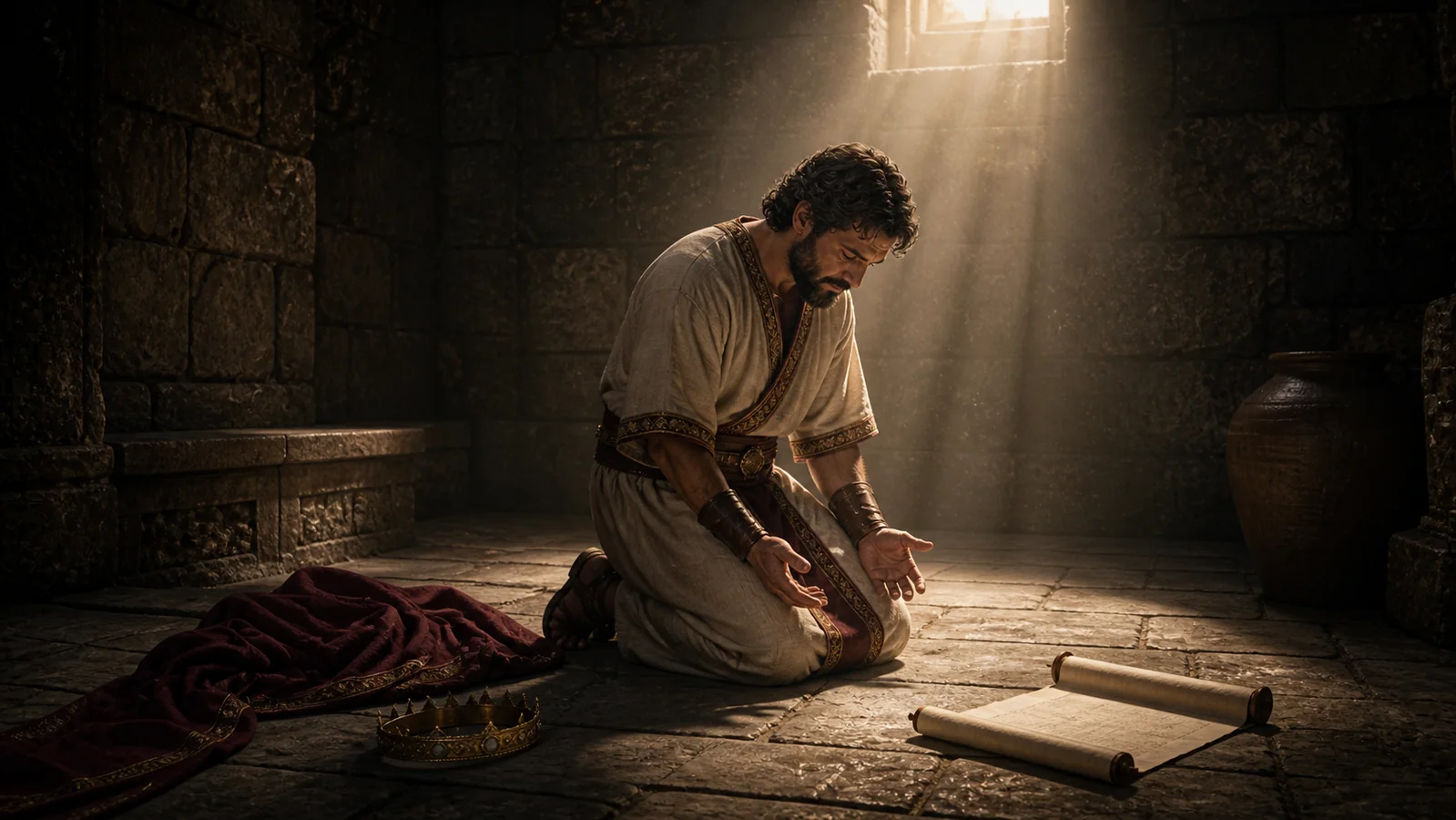
David’s confession before Nathan was short, but Scripture gives us a fuller window into his repentance through Psalm 51. Its inspired superscription connects the psalm with Nathan’s coming to David after David had gone in to Bathsheba. We should not claim that every line was composed in the throne room or during one particular night, because the Bible does not give that setting. Yet the psalm reveals the heart of a man who had stopped hiding.
David appealed to God’s steadfast love and abundant mercy. He asked the Lord to blot out his transgressions, wash him thoroughly from his iniquity, and cleanse him from his sin. He did not minimize his guilt. He acknowledged that his sin was always before him and that God was right in His judgment.
He also understood that he needed more than relief from consequences. He needed inward renewal:
“Create in me a clean heart, O God, And renew a steadfast spirit within me.”
David asked not to be cast away from God’s presence. He pleaded for the joy of salvation to be restored and for a willing spirit to sustain him. He knew that religious performance could not replace true repentance. The sacrifice acceptable to God was “a broken spirit, a broken and a contrite heart.”
This does not turn David into the hero of the episode. His repentance cannot restore Uriah’s life, erase Bathsheba’s suffering, or prevent every consequence announced by Nathan. Nor does forgiveness mean that God regarded the sin lightly. The narrative holds mercy and judgment together: the Lord put away David’s sin, and the sword still entered his house.
Yet grace is unmistakably present. David had concealed his guilt, but God exposed it. David deserved death, but God spared him. David’s heart had become corrupt through desire, deception, and bloodshed, but he could still ask the Lord to make it clean. Repentance did not give him power to undo the past; it brought him back into truthful dependence upon the God he had offended.
Seven Days of Pleading
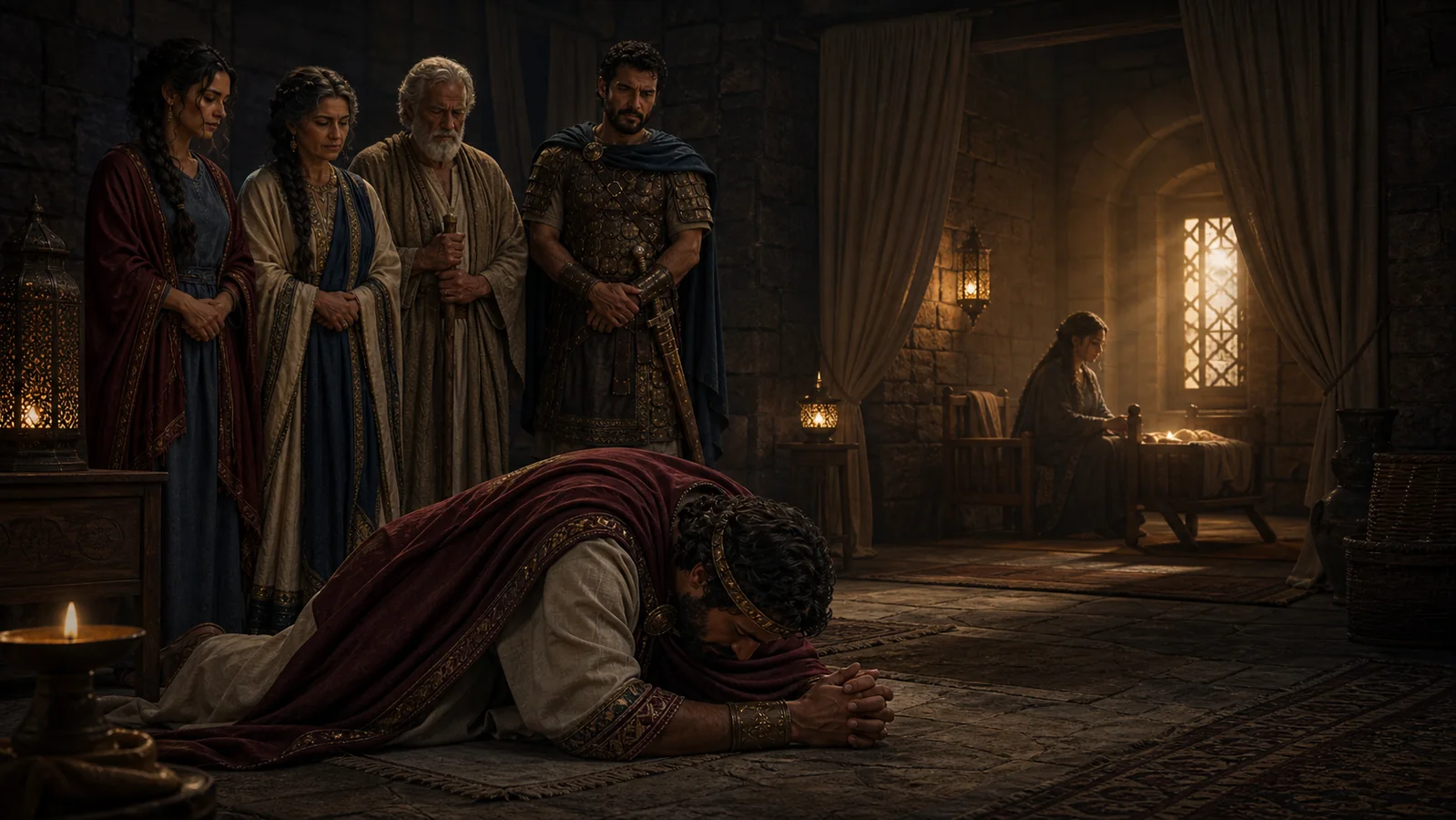
The child became ill, and David pleaded with God for him. He fasted, went in, and lay all night on the ground. The elders of his house came and tried to raise him, but he refused. He would not eat with them.
The biblical account centers on David’s response. It does not describe the nature of the child’s illness, list his symptoms, or give a day-by-day account of his decline. It also does not tell us where Bathsheba was during those seven days or what she said and did. We may reasonably imagine a grieving mother near her sick child, but that is imaginative reconstruction, not an explicit report of Scripture.
For David, the days became a prolonged appeal for mercy. Nathan had spoken the judgment clearly, but as long as the child lived, David continued to seek the Lord. His fasting was not a demand that God reverse His word. It was the desperate prayer of a father who knew that the Lord was free to show compassion.
The elders watched their king grow weak. They urged him to rise, but he would not be moved. The man who had once stood before Goliath now lay on the ground, unable to fight this judgment with a sling, a sword, or royal command. He could do nothing except humble himself and pray.
On the seventh day, the child died.
David’s servants were afraid to tell him. They reasoned that while the child was alive, David had not listened when they spoke to him. How, then, could they tell him that the child was dead? They feared he might harm himself. Their whispered conversation revealed the tension in the house: everyone knew what had happened, but no one wanted to carry the news to the grieving king.
David noticed that his servants were whispering and understood that the child was dead. He asked them directly, “Is the child dead?”
They answered, “He is dead.”
There is no need to embellish the moment. The plain sentence carries its own weight. The son born to David and Bathsheba had died, just as Nathan had said.
The loss belonged to Bathsheba as truly as it belonged to David. Yet Scripture does not record her words, her mourning customs, or the burial of the child. A retelling may pause to recognize the sorrow of a mother who had carried and borne him, but it must also honor the silence of the text. We do not know what she whispered, whether she held him at the end, or who took his body away. We know only that her son was gone.
David Rose from the Ground
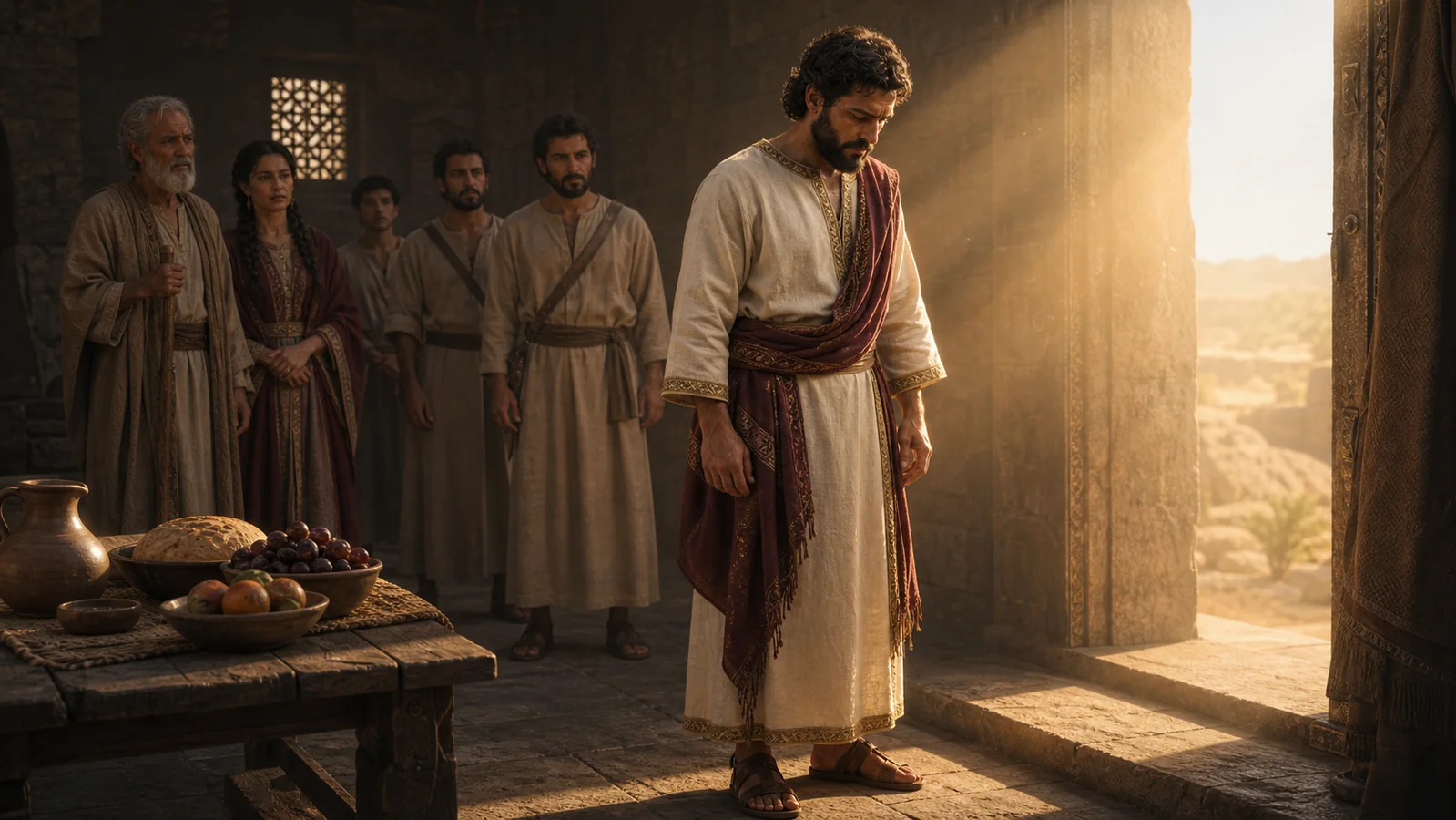
What David did next startled his servants.
He rose from the ground, washed, anointed himself, and changed his clothes. Then he went into the house of the Lord and worshiped. Afterward, he returned to his own house, asked for food, and ate what was set before him.
His servants could not understand. While the child lived, David had fasted and wept. Now that the child was dead, he rose and ate. They asked him why he behaved in this way.
David explained, “While the child was alive, I fasted and wept; for I said, ‘Who can tell whether the Lord will be gracious to me, that the child may live?’ But now he is dead; why should I fast? Can I bring him back again? I shall go to him, but he shall not return to me.”
David’s response was not indifference. His earlier fasting and weeping show the depth of his desire for the child to live. Nor was it proof that his grief had suddenly vanished. He rose because the period of pleading was over. While the child lived, David could ask God for mercy. Once the child died, David accepted what he could not change and worshiped the Lord.
There is a sober strength in that acceptance. David did not accuse Nathan of cruelty, charge God with injustice, or use his grief to deny the word that had exposed him. He had asked for grace while grace might still take the form of healing. When healing was not given, he still went before the Lord. Worship did not mean that the death no longer hurt. It meant that David acknowledged God as God even when the answer to his plea was no.
The servants had expected death to push him deeper into collapse. Instead, the certainty of death ended the uncertainty that had held him on the ground. He could no longer serve the child by fasting. He could not bargain his way backward into the previous week or command life to return. He therefore received food and resumed the responsibilities of the living.
This movement should not be used to impose a timetable on anyone else’s grief. The passage describes David; it does not command every bereaved parent to wash, worship, and eat at the same hour. Bathsheba’s response is not described at all. Faithful grief may include tears, silence, lament, practical duty, and the need for comfort over a long season. David’s actions show submission to the Lord, not a denial of human sorrow.
His words, “I shall go to him, but he shall not return to me,” have often comforted grieving believers. In the immediate context, David plainly recognized the finality of death: the child would not return to this life, while David would one day follow him into death. Christians may consider the verse alongside the fuller biblical hope of resurrection, but this passage itself does not develop all that David understood about the child’s state after death. We should receive the comfort without making the sentence claim more than it says.
The order of David’s actions is significant. He washed, worshiped, and ate. He did not pretend the child was still alive, and he did not remain forever on the floor as though grief gave him permission to abandon his calling. He bowed before the Lord and returned to life under God’s rule.
Comfort After Grief
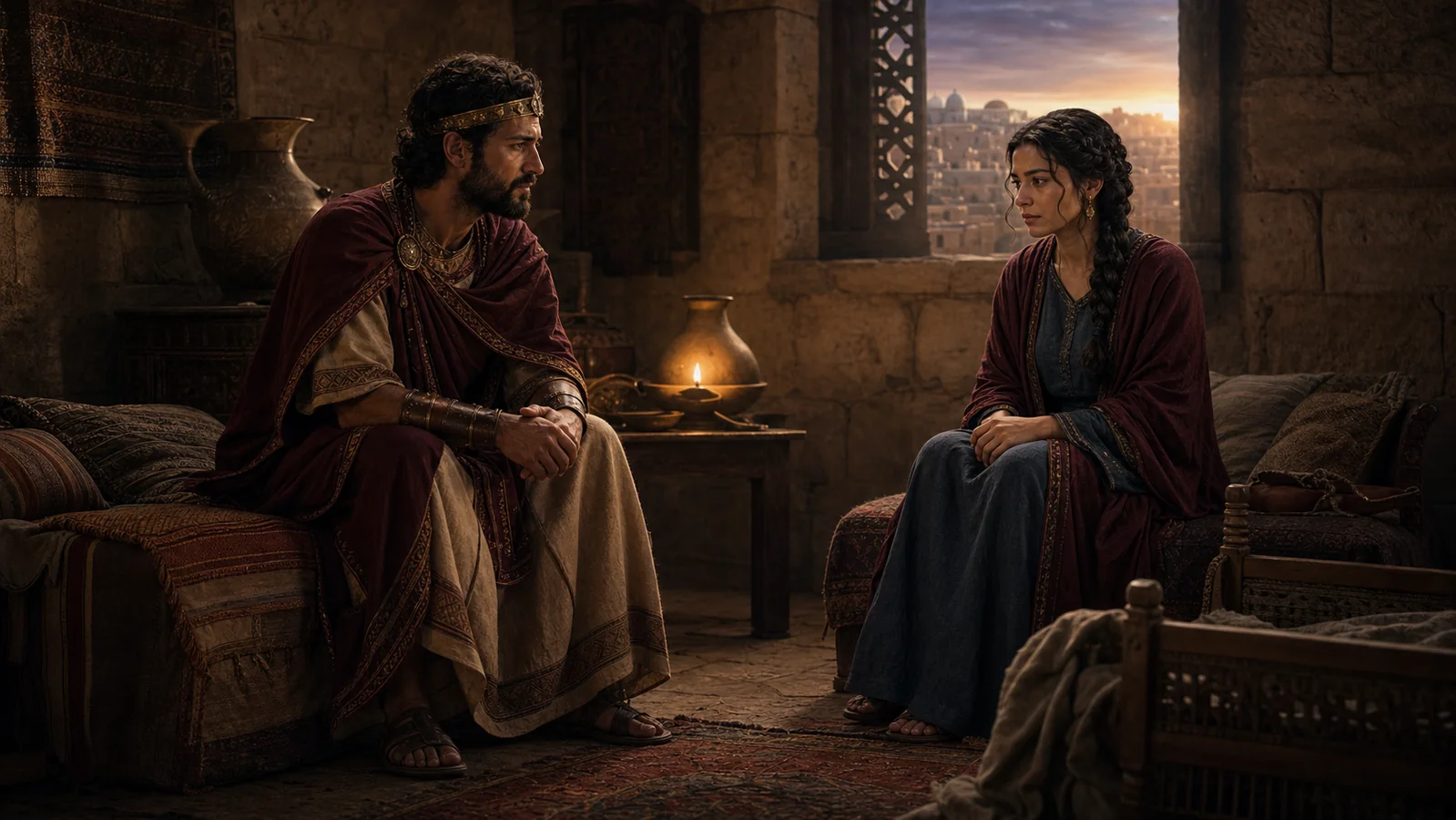
David then went to Bathsheba and comforted her. Scripture gives this brief statement without describing their conversation. It does not report an apology, a promise, or a long night of shared memories. Such scenes may be understandable in a dramatic retelling, but they must not be presented as biblical dialogue.
The simplicity of the verse is enough: David recognized Bathsheba’s grief and went to her. Until this point, the narrative has shown much of his own fasting and sorrow. Now it turns toward the bereaved mother. She needed comfort, and David sought to give it.
He lay with her, and she bore a son. They named him Solomon.
Solomon’s birth did not erase the first child or make the earlier sin good. Scripture never treats grace as a way of calling evil righteous. Uriah remained dead. The first son remained lost. The judgment in David’s household had only begun. Yet the Lord was not finished with David and Bathsheba.
The name Solomon is associated with peace, and peace would become central to his reign. David had been a man of war, but Solomon would later build the temple of the Lord during a time of rest. At his birth, however, none of that future had yet unfolded within the narrative. Here he was simply the son born after grief—a living child in a house that had known death.
For Bathsheba, the birth must have reopened memories as well as hope, though the text does not describe them. We may imagine the mixture of tenderness and fear familiar to a mother who has already buried a child, but Scripture does not tell us whether she feared another loss or how David responded during the pregnancy and birth. It gives no scene of the king pacing outside her chamber and no private promise that this child would live. Those images may make a retelling vivid, but they cannot be offered as remembered history.
What the text chooses to reveal is not the atmosphere of the delivery room but the Lord’s disposition toward the child. That emphasis directs the reader away from speculation and toward grace. Solomon’s significance did not rest merely on being a prince, receiving courtly attention, or representing a second chance to his parents. His story was anchored in the Lord’s love and purpose.
The text then makes a remarkable statement: “The Lord loved him.”
God sent word through Nathan the prophet, and the child was also called Jedidiah, meaning “beloved of the Lord,” because of the Lord. Nathan, who had carried the message of judgment, now carried this sign of divine love. The same prophet who had confronted David’s hidden sin was entrusted with a name that testified to God’s gracious purpose.
Scripture does not describe Nathan holding the baby, placing a hand upon him, or speaking additional prophecies to Bathsheba. It does not report the palace celebrating his two names or tell us what emotions Bathsheba felt when she heard the message. We may imagine that the words brought comfort after so much sorrow, but the inspired report is both shorter and stronger: the Lord loved Solomon, and He sent Nathan to name him Jedidiah.
That love did not mean Solomon’s path would be easy, nor did it mean every choice he later made would please the Lord. It meant that his life began under a gracious declaration that did not arise from human merit. The house was still marked by consequences, but it was not abandoned by God.
Judgment and mercy therefore stood side by side in the same family. The first child’s death testified to the seriousness of David’s sin and the truthfulness of Nathan’s word. Solomon’s birth and God-given name testified that judgment was not the end of the Lord’s dealings with them. Grace did not deny the past; it opened a future that neither David nor Bathsheba could create for themselves.
Solomon was not a replacement for the child who died, as though one life could cancel another. Nor should his birth be used to suggest that every bereavement will be followed by an equivalent earthly gift. This is the particular history of David’s house and of the king through whom God was advancing His covenant purposes. Its comfort rests in God’s freedom to show mercy, not in a formula promising that every loss will be balanced in the present life.
Bathsheba’s place in the story also began to change. She had first appeared as the wife of Uriah, summoned to David during a season of royal idleness and war. She became a widow, then a wife of the king, then a mother who lost her child. Now she was the mother of Solomon, the son whom the Lord loved. Her future role would involve protecting his claim and speaking at a decisive moment in David’s final days. But before that moment came, the royal family would pass through violence, shame, estrangement, and rebellion.
Nathan had said that the sword would not depart from David’s house. The fulfillment would not remain an abstract threat. It would be seen in David’s own sons and daughters.
The Sons of David
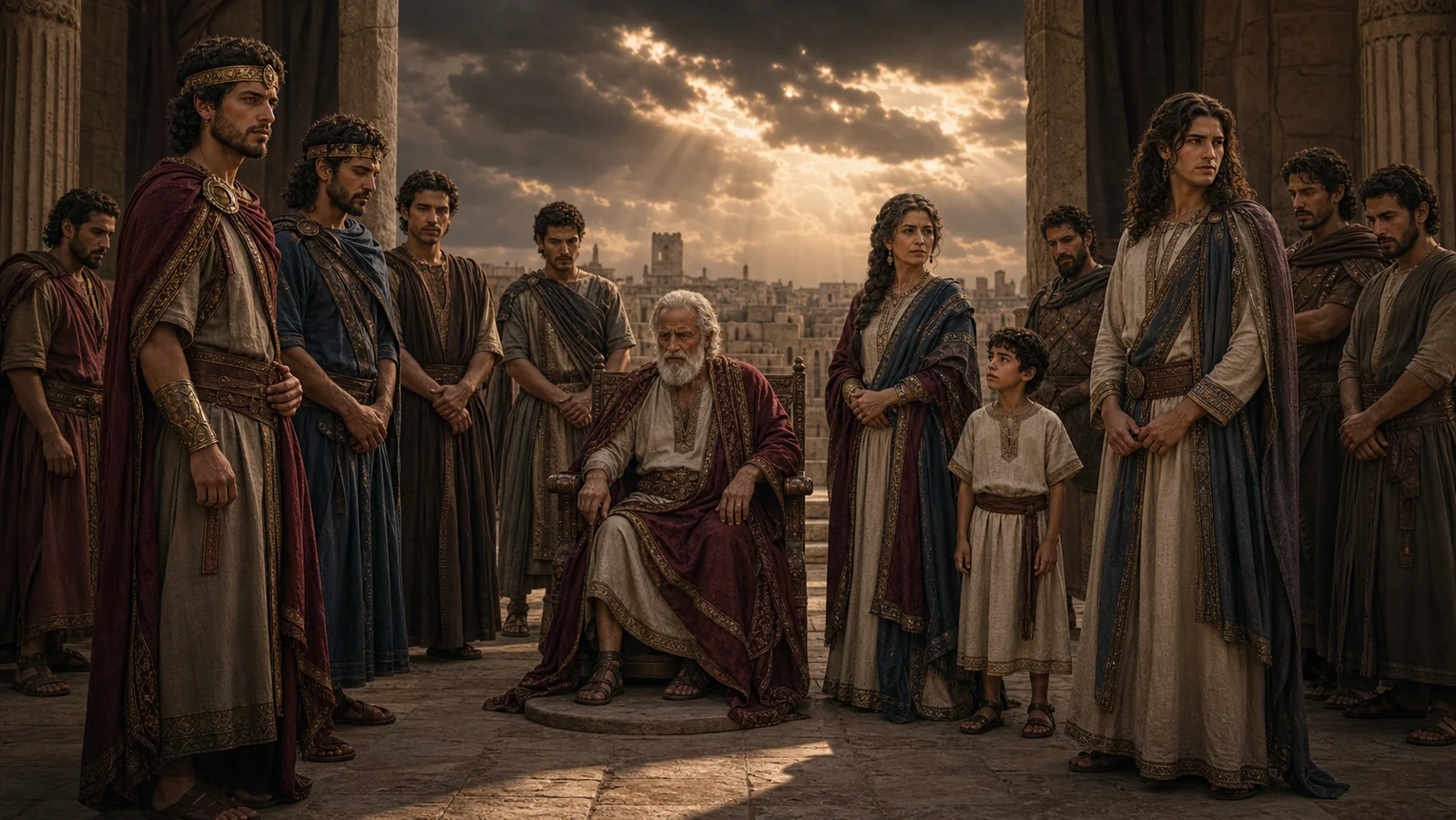
David’s household included children born to several wives. Amnon was his firstborn, the son of Ahinoam of Jezreel. Absalom was the son of Maacah, daughter of Talmai king of Geshur. Absalom’s sister was Tamar. Solomon, Bathsheba’s son, was younger than these children.
It is tempting to imagine the princes growing up together in a simple rivalry for David’s approval or the throne, but Scripture does not give us scenes from their childhood. It does not say that Amnon resented Absalom’s popularity as a boy, that Absalom watched Solomon with suspicion from an early age, or that Solomon displayed extraordinary wisdom in palace games and lessons. Those details go beyond the text.
The Bible does reveal that succession in David’s house would become a dangerous question. As the firstborn, Amnon held a prominent position. Absalom possessed royal blood through his mother as well as his father, and Scripture later emphasizes his striking appearance and his ability to attract the people. Solomon was beloved of the Lord and would eventually be chosen to reign, but at this point the narrative had not yet shown how his kingship would be secured.
The palace was therefore more than a family home. It was the center of a kingdom, and every fracture among the king’s children carried public consequences. Affection, inheritance, justice, and succession could not be separated easily. A father’s favoritism or passivity could become a national danger; a son’s private hatred could grow into political violence. The narrative does not invite us to reduce every event to competition for the throne, but it does show how sin within a ruler’s home can spread far beyond its rooms.
David had once been the overlooked youngest son in Jesse’s house. He knew what it meant to be underestimated, pursued, and denied security. Yet the account of his later years repeatedly shows him struggling to govern his own sons with the clarity he had often shown on a battlefield. His courage before foreign enemies did not automatically become wisdom in family discipline. The weakness is especially painful because David’s household needed both a loving father and a righteous king.
Bathsheba may well have been attentive to the dangers surrounding her son, but the text does not describe her advising young Solomon during these years or Nathan privately warning her to prepare him. We should not invent conversations to fill the silence. What can be said is that Solomon grew up in a family already living beneath Nathan’s warning. The outward splendor of the palace could not protect David’s children from the disorder that David’s own sin had helped unleash.
That disorder soon became visible through Amnon and Tamar.
Amnon and Tamar
Amnon developed a consuming desire for Tamar, the sister of Absalom and his own half-sister. Scripture calls it love at first, but the course of the story exposes it as selfish and destructive desire rather than faithful love. Tamar was a virgin, and Amnon became so distressed that he made himself ill because he thought it difficult to do anything to her.
Amnon had a crafty friend and cousin named Jonadab, the son of David’s brother Shimeah. Jonadab noticed Amnon’s misery and asked why the king’s son looked so troubled each morning. Amnon confessed his desire for Tamar.
Jonadab gave him a plan. Amnon should lie down and pretend to be sick. When David came to see him, Amnon should ask that Tamar be sent to prepare food in his sight and feed him from her hand.
Amnon followed the advice. When David visited, Amnon asked for Tamar to come and make food for him. David sent word to Tamar, telling her to go to her brother’s house and prepare food for him.
Tamar went because her father had sent her and because Amnon was her brother. The text gives no indication that she suspected his scheme. She took dough, kneaded it, made cakes in his sight, and baked them. Then she took the pan and served him, but he refused to eat.
Amnon ordered everyone else out of the room. After they had left, he told Tamar to bring the food into the inner chamber so that he could eat from her hand.
She carried the cakes to him. When she came near, he seized her and said, “Come, lie with me, my sister.”
Tamar resisted him. She addressed him as her brother and pleaded with him not to force her. She called the act disgraceful and said that such a thing should not be done in Israel. She asked where she could carry her shame and warned that he would become like one of the fools in Israel. In desperation, she urged him to speak to the king, saying that David would not withhold her from him.
Her words should not be read as biblical approval for a marriage between them. The law prohibited such a union. Tamar was trying every argument available to stop the immediate violence. She appealed to kinship, Israel’s moral order, her own future, Amnon’s reputation, and the king’s authority. Amnon listened to none of it.
He was stronger than she was. He forced her and violated her.
Scripture reports the evil plainly. Tamar did not cause it, invite it, or share Amnon’s guilt. She protested repeatedly. The shame belonged to the man who overpowered her, not to the woman he harmed.
Then Amnon’s so-called love turned into intense hatred. The hatred with which he hated her was greater than the love with which he had claimed to love her. This sudden reversal reveals the nature of his desire. He had not sought Tamar’s good. He had wanted possession and gratification. Once he had taken what he wanted, he treated her presence as an accusation.
“Arise, be gone,” he told her.
Tamar protested again. Sending her away, she said, would be an even greater wrong than what he had already done. Once more Amnon refused to listen. He called his servant and ordered him to put her outside and bolt the door behind her.
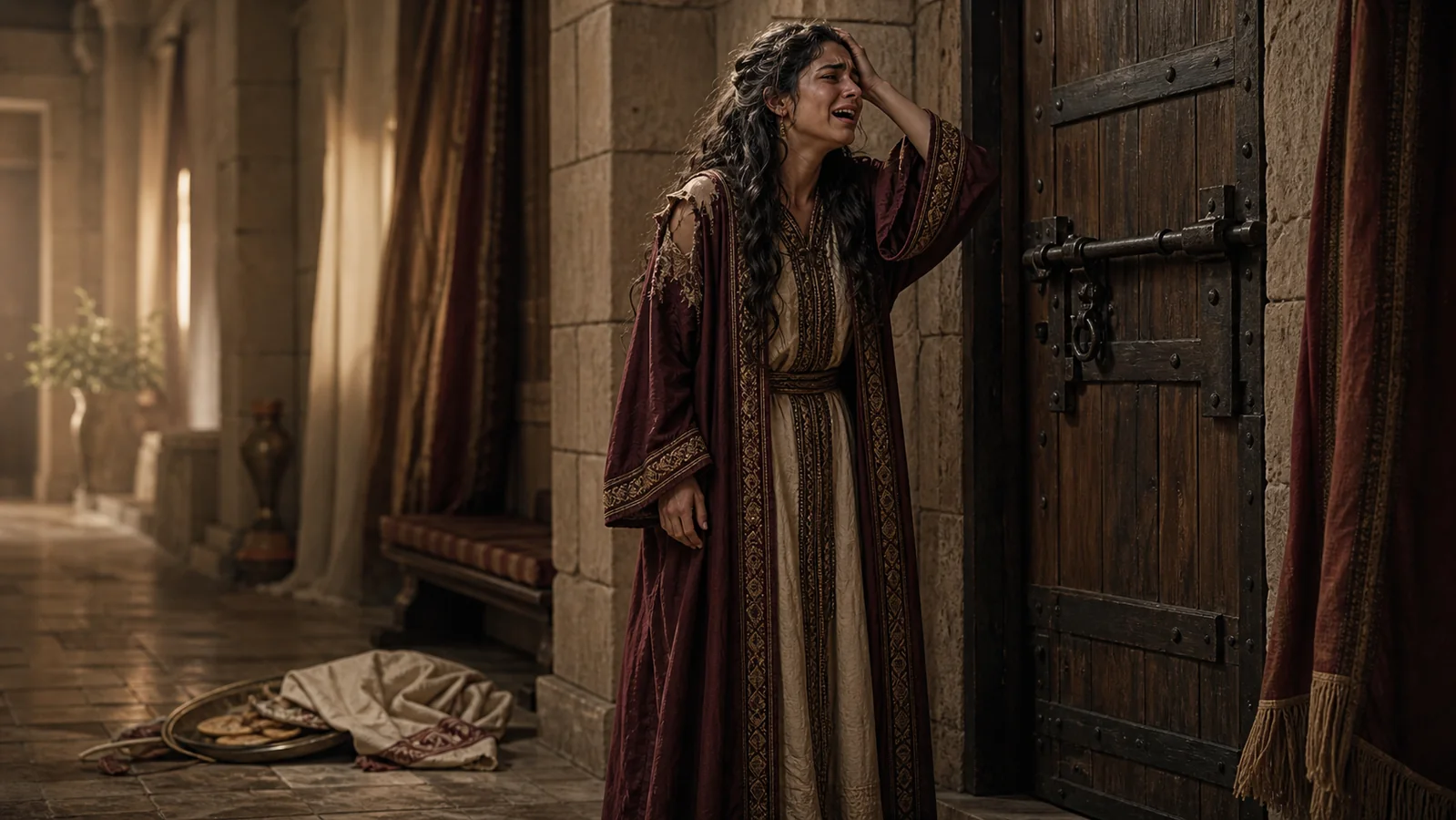
Tamar had been wearing the long robe worn by the virgin daughters of the king. After she was driven out, she put ashes on her head, tore the robe, laid her hand upon her head, and went away crying aloud.
The account does not hide her devastation. It gives visible signs of grief and public lament. Tamar had entered her brother’s house in obedience to her father and had left dishonored by violence. Her future had been altered by another person’s sin.
Absalom’s Silence
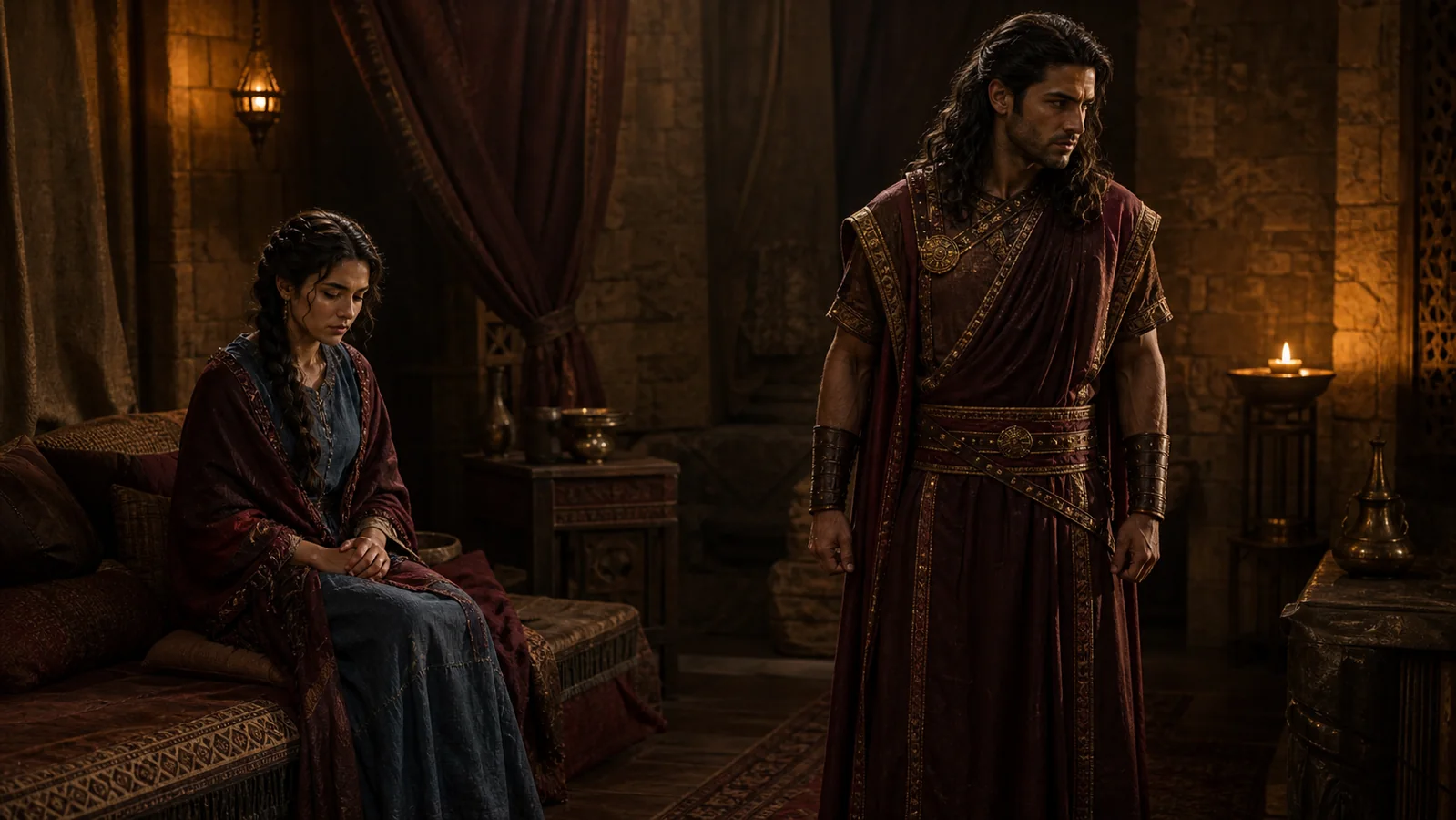
Absalom saw his sister and understood that something terrible had happened. He asked, “Has Amnon your brother been with you?” Then he told her to be quiet for the present because Amnon was her brother and urged her not to take the matter to heart.
Those words can sound as though Absalom were minimizing Tamar’s suffering. The wider narrative shows that he did not forget what Amnon had done. His anger became settled hatred. Still, Scripture does not explain everything he meant in that first conversation. He may have been trying to protect and calm her while he formed his own response, but that is an inference, not an explicit statement.
Absalom took Tamar into his home, and she remained there desolate. The word is severe. The royal family could give her shelter, but it could not restore what had been taken from her. Her sorrow became part of the continuing ruin within David’s house.
When David heard all these things, he became very angry. Yet the biblical text records no punishment of Amnon. Some ancient textual witnesses add an explanation that David would not grieve Amnon because he loved him as his firstborn, but that sentence is not present in all Hebrew textual traditions. What is clear in the received narrative is that David was furious and that no act of justice is reported.
That silence is troubling. David was not only Amnon’s father; he was Tamar’s father and Israel’s king. He had authority to address the crime. His failure to act left Tamar desolate, Amnon unpunished, and Absalom’s anger to harden in private.
The text does not tell us why David did nothing. Perhaps his own sexual sin weakened his resolve to judge his son. Perhaps affection for his firstborn restrained him. Perhaps family loyalty, guilt, or political calculation left him paralyzed. Each explanation is possible, but none should be stated as certain. Scripture records his anger and then turns to Absalom.
Absalom spoke neither good nor bad to Amnon. He hated Amnon because Amnon had violated Tamar, his sister.
This was not peace. It was controlled silence.
Bathsheba is not named in the account of Amnon and Tamar. The text does not say that she watched from the edges of the court, confronted David, or immediately recognized what Absalom would become. Because she lived in the royal household, we may imagine that news of such a catastrophe affected everyone in it, but we cannot assign her private observations or conversations that Scripture does not provide.
What can be seen clearly is the gathering danger. Nathan’s warning was unfolding within David’s own house. One son had violated his sister. The king had become angry but had not administered recorded justice. Another son received the wounded woman into his home and nursed a silent hatred against her attacker.
Absalom’s later conduct would reveal his patience, ambition, and skill at winning public affection. In years to come he would stand by the city gate, tell those seeking judgment that their claims were good, lament that no one had been appointed to hear them, and wish aloud that he were judge in the land. He would embrace those who approached him and steal the hearts of the men of Israel. But that political campaign belonged to a later stage of his story, after further bloodshed and estrangement. It should not be moved ahead of Tamar’s tragedy as though his rebellion had already begun.
For now, the threat was hidden behind a son’s silence.
David had pronounced judgment on the rich man in Nathan’s parable because the man had shown no pity. Now injustice had entered David’s own family, and the king’s failure to answer it allowed resentment to deepen. The sword had not finished its work.
The text does not tell us that Bathsheba knew exactly what Absalom planned, or even that he had yet formed a plan. It does not permit us to place prophetic certainty in her thoughts. Yet anyone watching the royal house could have seen reason for concern: Tamar was desolate, Amnon remained in his place, David’s anger had produced no recorded action, and Absalom no longer spoke to his brother.
Nothing had been resolved. The palace carried on, but beneath its order lay grief, guilt, and hatred. Amnon may have mistaken Absalom’s silence for restraint. David may have hoped time would quiet the family. Scripture does not tell us. It leaves us with the ominous fact that Absalom hated Amnon because of what he had done to Tamar.
Concern now settled over David’s house—not only because of Amnon’s evil, but because Absalom’s quiet anger had begun to take root.
The Sword Falls Again
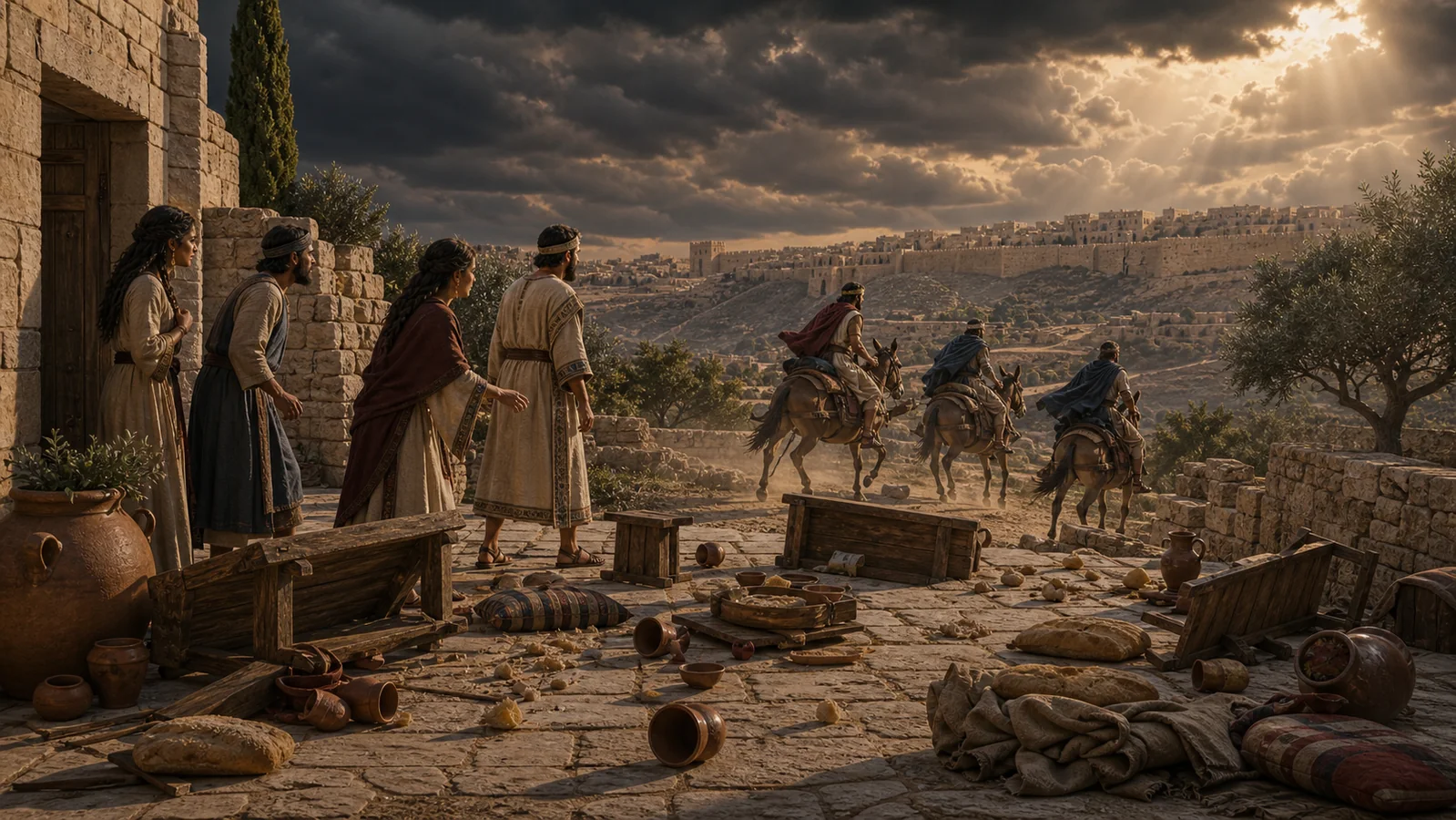
For two full years, Absalom said nothing to Amnon—neither good nor bad. Outwardly, the court continued. David’s sons still appeared together as members of the royal household, and the king still ruled from Jerusalem. Yet beneath that surface lay an unaddressed horror: Amnon had violated his half sister Tamar, and Absalom hated him for it.
The text does not tell us what Bathsheba knew of Absalom’s plans or how much she saw of the tension within David’s family. It does tell us that Absalom took Tamar into his own house and that she remained there, a desolate woman. David was very angry when he heard what Amnon had done, but the account records no judgment against Amnon. Silence did not heal the wound. It gave Absalom’s hatred time to harden into revenge.
When Absalom’s sheep were being sheared at Baal-hazor, near Ephraim, he invited the king and all the king’s servants to a feast. David declined, not wanting to burden his son with the expense of entertaining the whole royal household. Absalom then pressed him to allow Amnon to attend. David asked why Amnon should go, but Absalom continued urging him until the king permitted Amnon and the other royal sons to join the celebration.
Absalom had already commanded his servants what to do. They were to watch until Amnon’s heart was merry with wine. At Absalom’s signal, they were to strike and kill him. He told them not to be afraid, for the command was his.
The servants obeyed. Amnon died at the feast, and David’s other sons fled, each on his mule. Before they reached Jerusalem, a report came that Absalom had killed all the king’s sons and that not one remained alive. David tore his garments and lay on the ground. His servants stood nearby with their clothes torn as the palace braced itself for unbearable loss.
Jonadab, the same shrewd cousin who had helped Amnon devise the plan against Tamar, corrected the report. Only Amnon was dead, he said; Absalom had determined this from the day Amnon violated his sister. Soon the other royal sons arrived, weeping loudly, and David and his servants wept with them.
Absalom fled to Geshur, where his maternal grandfather Talmai was king. He remained there for three years. David mourned for Amnon, but in time his heart went out toward Absalom. The house had not escaped the judgment Nathan announced after the death of Uriah: the sword was rising from within David’s own family.
Bathsheba is not named in this part of the biblical account. We should therefore resist inventing private conversations or assigning her thoughts the text does not reveal. Yet these events formed the world in which her son Solomon was growing. Amnon, David’s firstborn, was dead. Absalom was both avenger and murderer, beloved son and dangerous exile. The royal household was learning that ignored sin does not remain safely buried.
Absalom Returns—but Is Not Reconciled
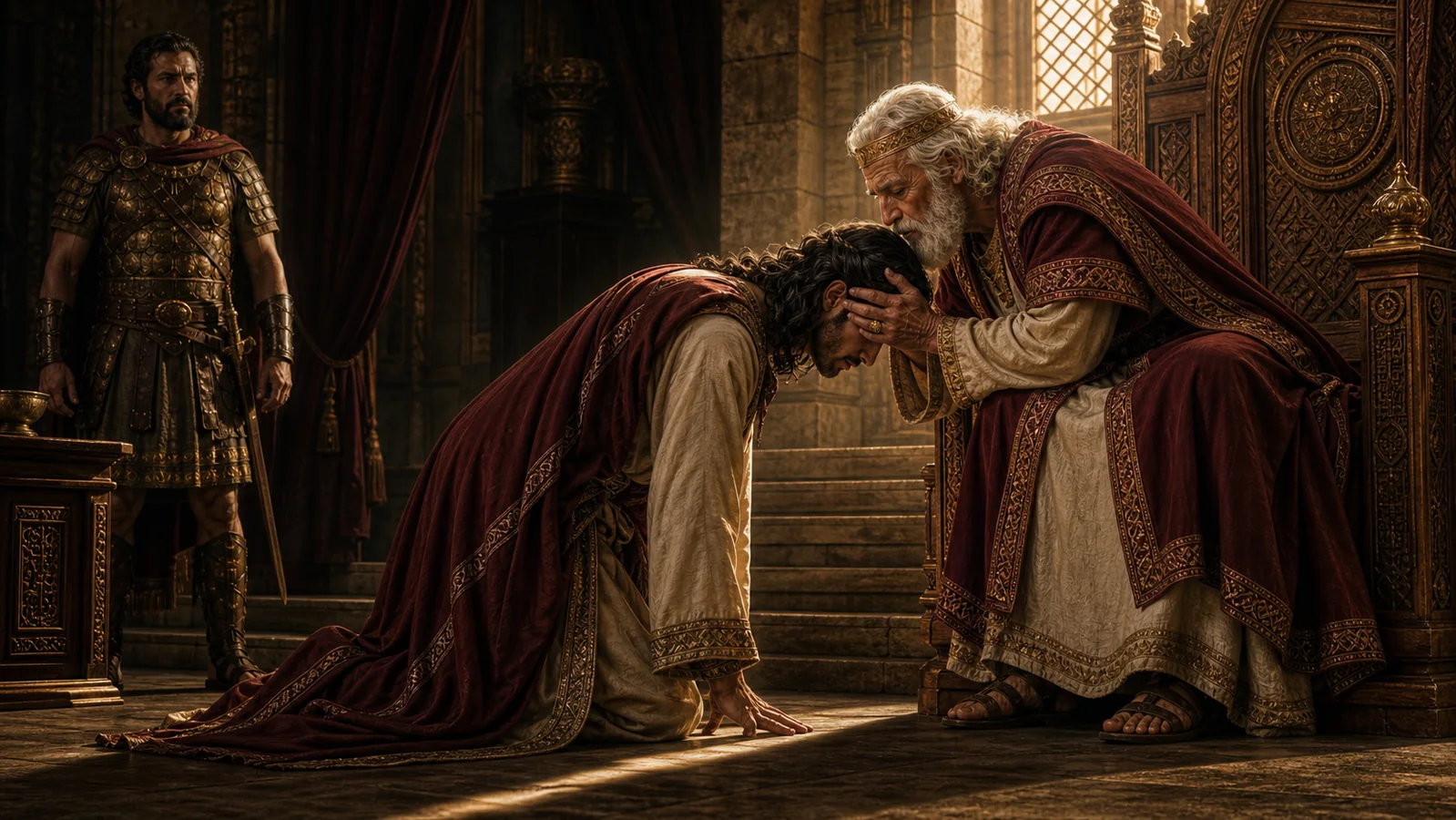
Joab recognized that David longed for Absalom. Through a wise woman from Tekoa, he persuaded the king to allow the exile to return. David granted Absalom permission to come back to Jerusalem, but with a condition: Absalom was to go to his own house and was not to see the king’s face.
The return therefore stopped short of reconciliation. Absalom lived for two years in Jerusalem without being admitted to his father’s presence.
Scripture pauses to describe his striking appearance. In all Israel, no man was praised as highly for his beauty. From the sole of his foot to the crown of his head, the account says, there was no blemish in him. His hair was exceptionally heavy when he cut it. He also had three sons and a daughter, whom he named Tamar; she was a beautiful woman.
At last Absalom sent for Joab, hoping Joab would carry his appeal to the king. Joab did not come. Absalom sent again, and again Joab refused. Absalom then ordered his servants to set Joab’s barley field on fire. That finally brought the commander to his house.
Absalom’s demand was direct. Why had Joab brought him back from Geshur if he was still excluded from the king? It would have been better, he said, to remain in exile. He wanted to see David’s face; if guilt worthy of death remained in him, the king could put him to death.
Joab carried the message. David summoned Absalom, who came and bowed with his face to the ground. David kissed him.
That kiss ended the formal separation, but Scripture does not say that Absalom repented of murder or that David dealt honestly with the sins that had divided the family. It would go beyond the text to describe the reconciliation as complete. Father and son stood together again, but the next events show that peace had not taken root.
Absalom Steals the Hearts of Israel
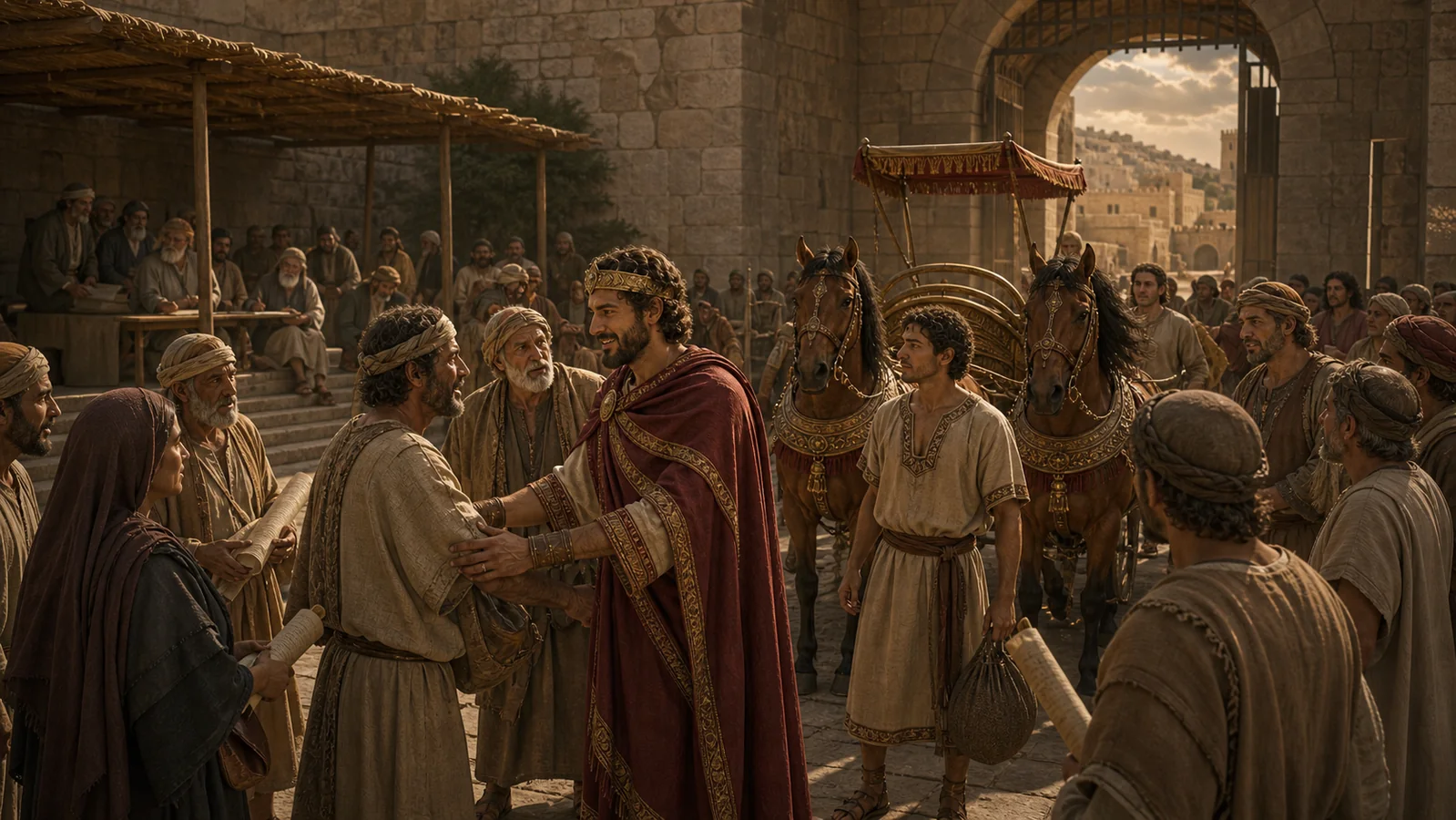
After this, Absalom acquired a chariot and horses, with fifty men running before him. He rose early and stood beside the road leading to the city gate, where legal matters were heard. Whenever someone came to bring a dispute before the king, Absalom called out, asked his city and tribe, and assured him that his claims were good and right. Then he added that no one appointed by the king was available to hear him.
“If only I were judge in the land,” he said in effect. Then everyone with a complaint could come to him, and he would give justice.
When anyone approached to bow, Absalom reached out, took hold of him, and kissed him. In this way he cultivated public affection and stole the hearts of the people of Israel. His conduct was not merely courteous. It was a patient political campaign built on grievance, flattery, and the suggestion that David’s government no longer cared for ordinary people.
After four years, Absalom asked David for permission to go to Hebron, claiming that he needed to fulfill a vow made while he lived in Geshur. David told him to go in peace. But the language of worship concealed rebellion. Absalom had sent secret messengers throughout the tribes with instructions: when the trumpet sounded, they were to proclaim that Absalom was king at Hebron.
Two hundred invited men traveled with him from Jerusalem in innocence, unaware of the conspiracy. Absalom also summoned Ahithophel the Gilonite, one of David’s counselors. The conspiracy gained strength, and the number of Absalom’s supporters continued to grow.
The source narrative imagines Bathsheba watching these developments and warning Solomon. Scripture gives us no such scene. What it clearly reports is grave enough: while David still occupied the throne, his son deliberately gathered symbols of royal status, won public loyalty, misused the language of devotion, and declared himself king.
A messenger reached David with the news that the hearts of Israel had gone after Absalom. David immediately ordered his servants in Jerusalem to flee. If they remained, he believed, Absalom might overtake them quickly, bring disaster upon the city, and strike its people with the sword.
David departed with his household and servants, though he left ten concubines to care for the palace. His loyal followers passed before him: the Cherethites, the Pelethites, and six hundred Gittites who had followed him from Gath. Ittai the Gittite refused David’s attempt to release him from service and pledged to remain with the king whether in life or death.
All the land wept as the people crossed the brook Kidron and moved toward the wilderness. Zadok and the Levites brought the ark of God, but David sent it back to Jerusalem. He would not use the ark as a guarantee of political survival. If he found favor in the Lord’s sight, he said, the Lord would bring him back to see it and its dwelling place again. If not, the Lord could do to him whatever seemed good.
David climbed the Mount of Olives barefoot, with his head covered, weeping. The people with him also covered their heads and wept as they climbed. When David learned that Ahithophel had joined Absalom’s conspiracy, he prayed, “O Lord, please turn the counsel of Ahithophel into foolishness.” Hushai the Archite then met him, and David sent Hushai back to Jerusalem to frustrate Ahithophel’s advice and relay information through the priests’ sons.
Bathsheba and Solomon are not named among those who fled, nor does the text specify where they remained during the rebellion. We may imagine the terror that seized everyone tied to David’s household, but we cannot turn that reasonable possibility into a reported fact. The biblical focus remains on David—once again outside Jerusalem, once again walking a wilderness road, and this time fleeing from his own son.
Rebellion, Judgment, and a Father’s Grief
Absalom entered Jerusalem, and Ahithophel advised him to go publicly to David’s concubines, whom the king had left to keep the palace. A tent was spread for Absalom on the roof, and he acted in the sight of all Israel. Nathan’s earlier word was being fulfilled openly: evil had risen from David’s own house, and what David had done secretly was answered by public humiliation.
Ahithophel next urged Absalom to let him pursue David immediately with twelve thousand men. His plan was to strike while David was weary and discouraged, kill the king alone, and bring the people back. Absalom and Israel’s elders initially approved.
But Hushai offered different counsel. He warned that David and his warriors were fierce and experienced and proposed that Absalom first gather a vast army from all Israel, then lead it personally. Absalom preferred Hushai’s grander plan. Scripture explains the deeper reason: the Lord had ordained to defeat Ahithophel’s good counsel in order to bring disaster upon Absalom.
Hushai sent warning through Zadok and Abiathar. David and his people crossed the Jordan and reached Mahanaim. When Ahithophel saw that his counsel had not been followed, he put his affairs in order and took his own life.
Support came to David in exile. Shobi, Machir, and Barzillai brought bedding, vessels, grain, beans, lentils, honey, curds, sheep, and cheese for the king and the weary people with him. Even in the wilderness, David was not abandoned.
David organized his army under Joab, Abishai, and Ittai the Gittite. He wanted to go into battle, but the people insisted that his life was too valuable to risk. As the troops marched out, everyone heard his command to the three commanders: “Deal gently for my sake with the young man Absalom.” David still spoke as a father, even though Absalom had sought his throne and his life.
The battle spread through the forest of Ephraim. Twenty thousand men fell, and the forest consumed more people that day than the sword. Absalom encountered David’s servants while riding his mule. As he passed beneath the thick branches of a great oak, his head caught fast in the tree. The mule continued, leaving him suspended between heaven and earth.
The text says that his head was caught; it does not explicitly say his hair was the cause, though the earlier description of his hair has often led readers to make that connection. We should not state more than the account does.
A man saw Absalom and reported it to Joab. When Joab demanded to know why he had not killed him, the man answered that no reward could persuade him to violate the king’s command. Joab then went to Absalom, thrust three weapons into his heart while he was still alive in the oak, and allowed ten armor-bearers to surround and strike him. They threw his body into a great pit and raised a large heap of stones over it.
The rebellion collapsed. Yet victory brought David no joy.
Ahimaaz, the son of Zadok, ran to carry news, but when David asked whether Absalom was safe, he gave no clear answer. A Cushite messenger then arrived. Again David asked, “Is it well with the young man Absalom?” The messenger answered indirectly but unmistakably: may all the king’s enemies become like that young man.
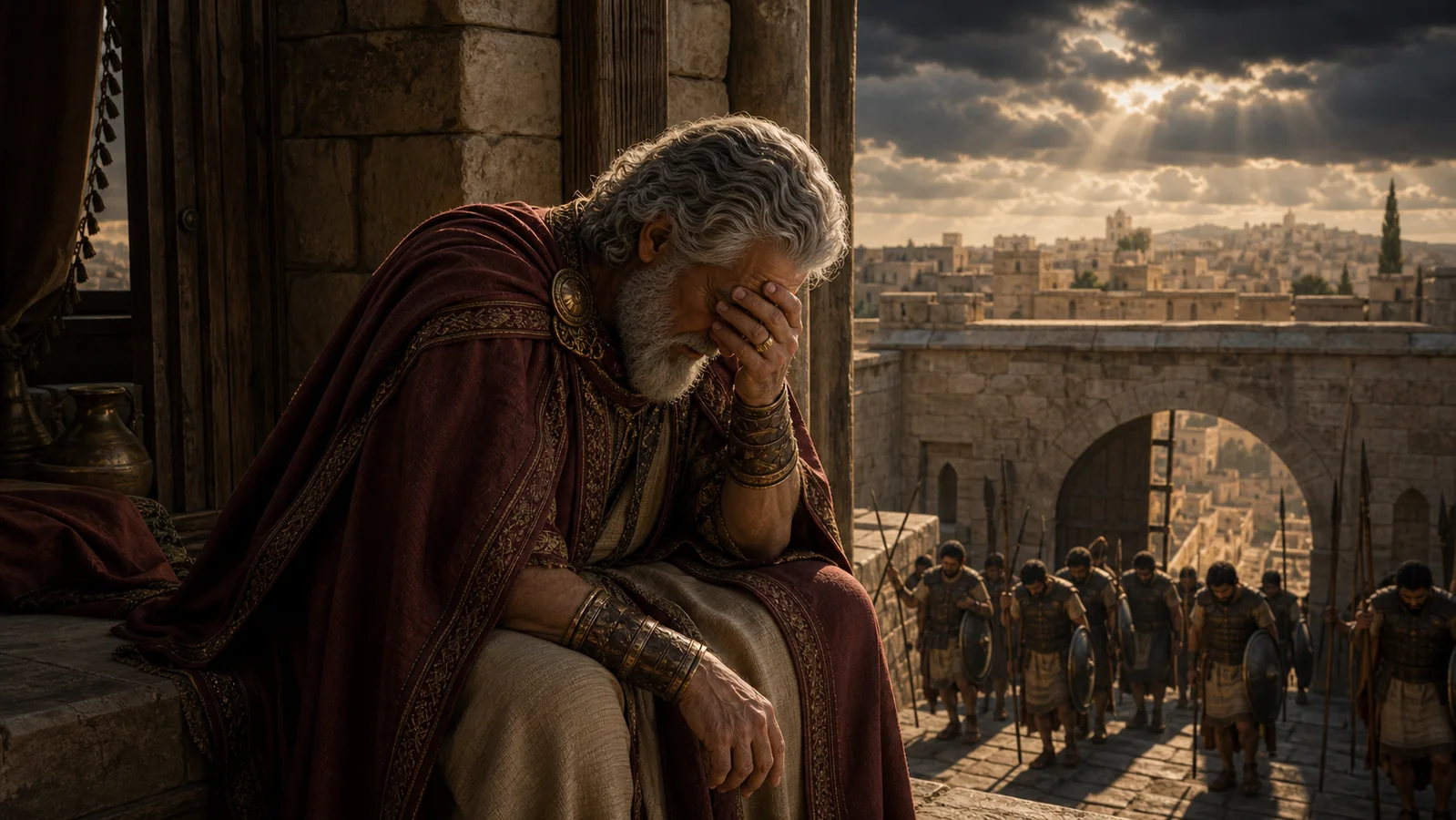
David understood. He went to the chamber over the gate and wept.
“O my son Absalom, my son, my son Absalom! Would I had died instead of you, O Absalom, my son, my son!”
The army entered the city quietly, as though it had been defeated. Joab confronted David and warned that his public grief shamed the men who had saved his life, his family, and his kingdom. If David did not rise and speak to them, Joab said, not one man would remain with him by nightfall. David therefore arose and sat in the gate, where the people came before him.
Scripture assigns that intervention to Joab, not Bathsheba. A dramatic retelling may picture the larger royal household grieving nearby, but it should not transfer Joab’s words or actions to Bathsheba. The truth is more severe and more complex: Joab had disobeyed David by killing Absalom, yet Joab also forced the grieving king to acknowledge the living soldiers whose loyalty had preserved him.
David returned to Jerusalem after further tension among the tribes and another revolt led by Sheba son of Bichri. The sword had not left his house, and turmoil had not entirely left his kingdom. But Absalom’s attempt to take the throne was over.
David’s Final Years
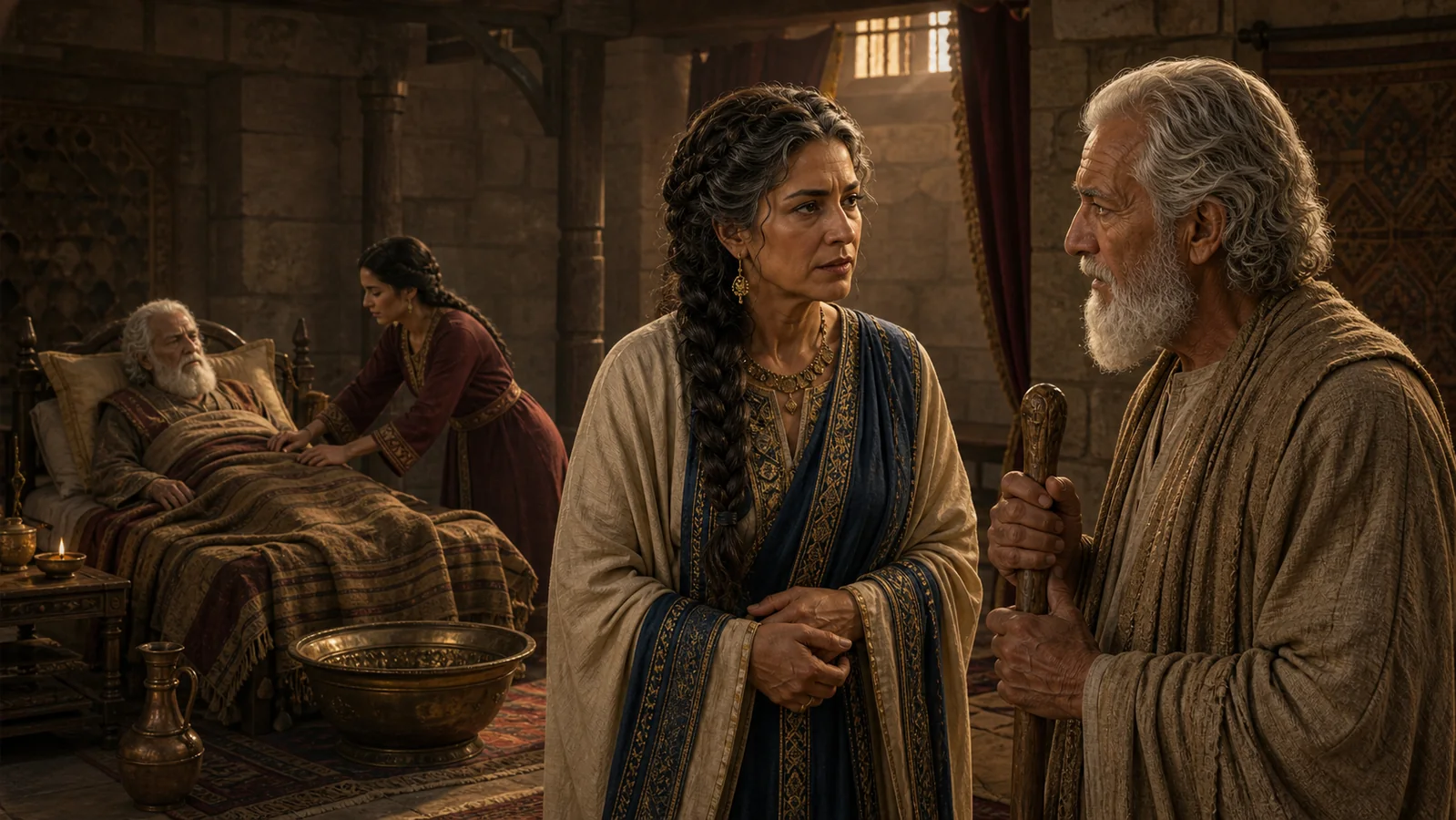
David grew old. First Kings tells us that even when he was covered with clothes, he could not keep warm. His servants searched throughout Israel for a young woman to attend him and found Abishag the Shunammite. She cared for the king and lay beside him to provide warmth, but the text expressly says that David did not know her sexually.
The once-vigorous warrior was nearing death, and the unresolved question of succession became urgent. The servants’ solution to David’s physical weakness could warm his body, but it could not settle the kingdom. Everyone near the court could see that the reign was ending. Unless David named and installed his successor, his sons and their supporters would decide the matter by maneuver, force, or bloodshed.
Adonijah, the son of Haggith, exalted himself and announced, “I will be king.” Like Absalom before him, he prepared chariots and horsemen and fifty men to run before him. These were public signs of royal pretension, designed to make his claim appear established before it had been lawfully confirmed. Scripture adds a painful detail about David’s fatherhood: the king had never displeased Adonijah by asking why he behaved as he did. Adonijah was handsome and had been born after Absalom, making him the eldest surviving son named in the succession narrative.
The resemblance to Absalom is difficult to miss. Both men were praised for their appearance. Both surrounded themselves with runners and the visible display of princely power. Both advanced their claims while David failed to restrain them. Yet Adonijah did not begin by winning the city gate or raising an army in Hebron. He built a court faction around senior figures whose names carried authority.
He gained the support of Joab, commander of the army, and Abiathar the priest. Their presence could make his cause look legitimate. Joab had commanded David’s forces for many years, and Abiathar had shared David’s hardships from the days of Saul. Their decision to support Adonijah showed how deeply the palace had divided as David weakened.
But Zadok the priest, Benaiah son of Jehoiada, Nathan the prophet, Shimei, Rei, and David’s mighty men did not join him. The division was therefore not merely between brothers. It ran through the priesthood, the military leadership, the prophetic court, and the old circle of David’s loyal warriors.
Adonijah held a sacrificial feast near the stone of Zoheleth beside En-rogel. Animals were killed in abundance, food was prepared, and invited supporters gathered near Jerusalem. Adonijah invited his brothers, the king’s sons, and the royal officials of Judah. He did not invite Nathan, Benaiah, the mighty men, or Solomon. The exclusions revealed the nature of the feast. This was not an innocent family celebration but an attempt to establish a kingship before David had publicly installed his successor.
The account does not say that Adonijah was formally anointed at En-rogel. It says that he exalted himself, gathered supporters, and hosted a feast at which his company acclaimed him. His movement depended upon creating the appearance of an accomplished fact: if enough important men ate at his table and called him king, perhaps the rest of Israel would accept what had already been staged.
Solomon’s absence carried an unmistakable warning. Adonijah had invited the other royal sons but deliberately left out the one whom Bathsheba said David had sworn to enthrone. Nathan understood that if Adonijah’s claim succeeded, Bathsheba and Solomon would be in mortal danger. In a contested monarchy, a rival heir did not simply lose an office. He could be treated as a future center of rebellion and removed.
Nathan went to Bathsheba with an urgent question: had she not heard that Adonijah had become king without David’s knowledge? He advised her how to save her own life and Solomon’s. She was to go to David, remind him of his oath that Solomon would reign, and ask why Adonijah had become king. Nathan would then enter and confirm her report.
This is one of the few scenes in these chapters in which Scripture clearly records Bathsheba’s words and actions. She did not merely watch from a distance. At a decisive moment, she entered the king’s presence and spoke.
David was very old, and Abishag was attending him when Bathsheba bowed before him. She reminded him of the oath he had sworn by the Lord: Solomon would reign after him and sit on his throne. Yet Adonijah had made himself king without David’s knowledge. He had sacrificed many animals and invited the king’s sons, Abiathar, and Joab, while excluding Solomon. All Israel, Bathsheba said, was waiting for David to declare who should succeed him. If David died without acting, she and Solomon would be treated as offenders.
Her warning was realistic. A disputed succession could make the rival claimant and his mother appear guilty even if they had not rebelled. Bathsheba did not claim the throne for herself; she asked the king to keep his sworn word concerning Solomon.
While she was speaking, Nathan arrived. He asked whether David had decreed that Adonijah should reign, since Adonijah’s supporters were already feasting and crying, “Long live King Adonijah!” Nathan emphasized that he, Zadok, Benaiah, and Solomon had not been invited. Had David done this without informing his servants who should sit on his throne?
The combined testimony stirred David to act.
Solomon Is Anointed King
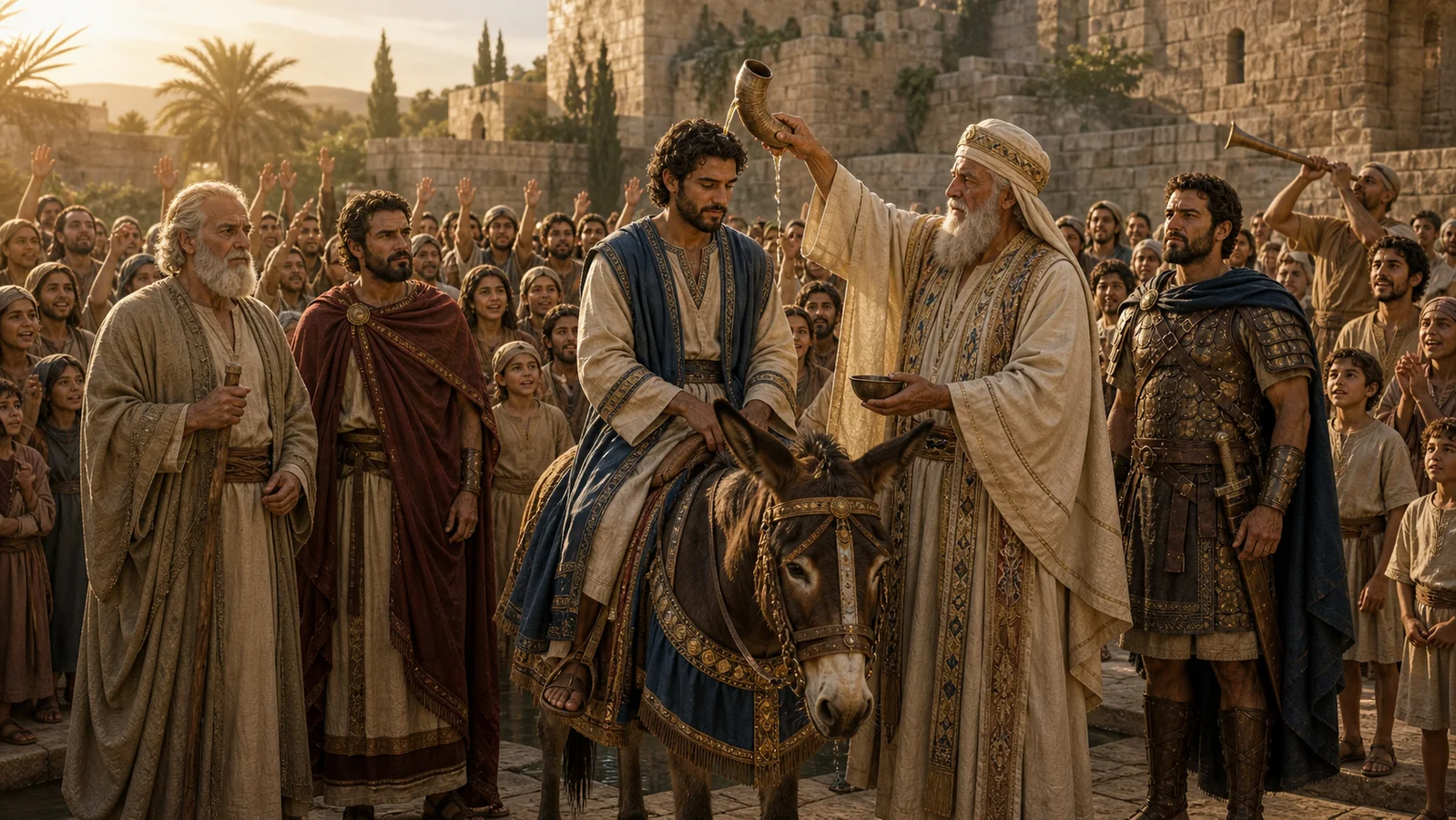
David called Bathsheba back into his presence and reaffirmed his oath. As surely as the Lord lived—the Lord who had redeemed him from every distress—he would fulfill that very day what he had sworn by the God of Israel: Solomon would reign after him and sit upon his throne.
Bathsheba bowed with her face to the ground and said, “May my lord King David live forever.” It was the conventional blessing of loyalty, spoken even as David prepared to place the kingdom in her son’s hands.
David summoned Zadok, Nathan, and Benaiah. He commanded them to take the royal servants, place Solomon on the king’s own mule, and bring him down to Gihon. There Zadok and Nathan were to anoint him king over Israel. The trumpet would sound, and the people would proclaim, “Long live King Solomon!” Then Solomon was to return, sit on David’s throne, and reign in David’s place over Israel and Judah.
Benaiah answered, “Amen.” He prayed that the Lord would be with Solomon as He had been with David and would make Solomon’s throne greater than David’s throne.
The procession moved through Jerusalem exactly as David commanded. Solomon rode on the king’s mule to Gihon. Zadok took the horn of oil from the tent and anointed him. The trumpet sounded. The people shouted, “Long live King Solomon!” They followed him with pipes and great rejoicing, so that the earth seemed to split with the sound.
Each element publicly answered Adonijah’s private maneuvering. Solomon rode the animal belonging to David, showing that his authority came from the reigning king. Zadok and Nathan anointed him under David’s command, joining priestly and prophetic witness to the royal decree. The trumpet made the decision known beyond the palace, and the people’s rejoicing turned David’s promise into a visible transfer of rule. Adonijah had tried to gather enough supporters to make himself king; Solomon was sent out by the king and brought back to sit on the king’s throne.
The celebration reached Adonijah’s feast. Joab heard the trumpet and asked why the city was in an uproar. Jonathan, son of Abiathar, arrived with the news: David had made Solomon king. Zadok, Nathan, and Benaiah had accompanied him on the royal mule; he had been anointed at Gihon; and Solomon now sat on the royal throne. David’s servants had blessed the king, praying that Solomon’s name and throne would become even greater than David’s. David himself had bowed in worship on his bed and thanked the Lord that he had lived to see a successor seated upon his throne.
Adonijah’s guests were afraid. The coalition dissolved as each man went his own way. Adonijah fled to the altar and took hold of its horns, seeking protection. He asked Solomon to swear that he would not put him to death.
Solomon’s first response combined mercy with a warning. If Adonijah proved himself worthy, not one hair of his head would fall; if wickedness was found in him, he would die. Adonijah came down, bowed before Solomon, and was sent to his house.
Solomon’s public anointing did not mean that David died that same day. Before his death, David assembled Israel’s leaders and charged Solomon concerning the temple, as Chronicles records. He acknowledged that he had desired to build a house for the Lord but had been prevented because he had shed much blood. Solomon, a man of rest, would build it. David supplied plans, materials, organization, and public encouragement for the work.
Then, as First Kings records, David gave Solomon a final personal charge. He told him to be strong, show himself a man, and walk in the Lord’s ways, keeping His statutes, commandments, rules, and testimonies as written in the Law of Moses. Faithfulness, not merely political skill, was the true foundation of the kingdom.
David also left Solomon difficult matters of justice. He reminded him of Joab’s bloodguilt in the deaths of Abner and Amasa. He instructed him to show steadfast kindness to the sons of Barzillai, who had supported David while he fled from Absalom. And he warned him concerning Shimei son of Gera, who had cursed David during that flight, though David had sworn not to put him to death at that time. These charges are morally sobering. They show that Solomon inherited not only a crown and a promise but also unsettled judgments from his father’s long and violent reign.
David died after reigning forty years—seven years in Hebron and thirty-three in Jerusalem. Scripture says that Solomon sat upon the throne of David his father, and his kingdom was firmly established.
Bathsheba Before Her Son
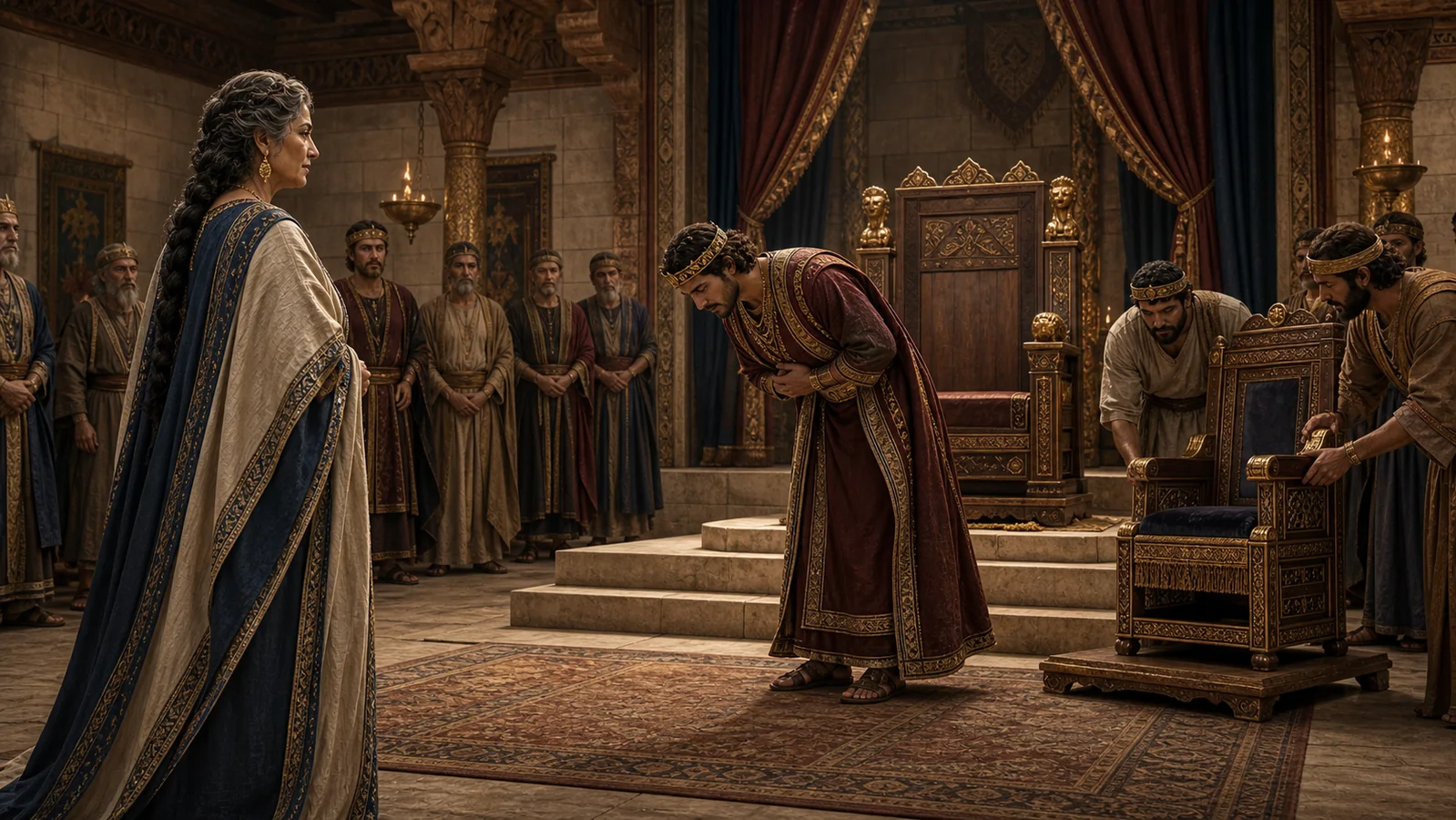
With Solomon on the throne, Bathsheba occupied the honored position of the king’s mother. The biblical narrative gives one especially clear picture of that honor.
Adonijah approached Bathsheba and assured her that he came peacefully. He reminded her that he had once expected the kingdom and that many in Israel had looked to him, but he acknowledged that the throne had gone to Solomon from the Lord. Then he asked her to request that Solomon give him Abishag the Shunammite as wife.
Bathsheba agreed to speak to the king. The text does not tell us whether she recognized the political implications of the request, whether she believed Adonijah’s claim that he came peacefully, or whether she simply intended to place the matter before Solomon. We should not assign her a motive beyond what is written.
When Bathsheba entered, Solomon rose to meet her, bowed before her, and sat upon his throne. He ordered another throne to be placed for the king’s mother, and she sat at his right hand. This is the clearest biblical image of Bathsheba as queen mother: publicly honored, granted direct access, and seated beside the king.
She told Solomon that she had one small request and asked him not to refuse her. Solomon invited her to speak. She then asked that Abishag be given to Adonijah as wife.
Solomon did not regard the request as small. In the world of royal succession, possession of a former king’s concubine or female attendant could function as a claim to the former king’s household and throne. Absalom had made such a claim publicly during his rebellion. Solomon therefore asked why Bathsheba did not request the kingdom for Adonijah as well, since he was the older brother and had the support of Abiathar and Joab.
Solomon swore that Adonijah’s request would cost him his life. He sent Benaiah, who struck Adonijah down.
This is not a scene of Bathsheba successfully gaining mercy for Adonijah. Nor does Scripture say that she urged Solomon to execute him. She carried the request; Solomon interpreted it as renewed ambition and rendered judgment. The distinction matters if Bathsheba’s role is to be represented faithfully.
The consequences spread to Adonijah’s former allies. Solomon removed Abiathar from the priesthood but spared his life because he had carried the ark before David and shared David’s afflictions. In this way the word of the Lord concerning Eli’s house was fulfilled. Joab fled to the tent of the Lord and took hold of the altar’s horns. Because of his bloodguilt and his part in Adonijah’s cause, Solomon ordered Benaiah to execute him. Benaiah then became commander of the army, and Zadok took Abiathar’s place as priest.
Solomon also restricted Shimei to Jerusalem under threat of death if he crossed the Kidron Valley. For three years Shimei complied. When he later left Jerusalem to recover runaway servants, he broke the terms of the oath and was executed. First Kings concludes this section by stating again that the kingdom was established in Solomon’s hand.
The Promise and the Responsibility
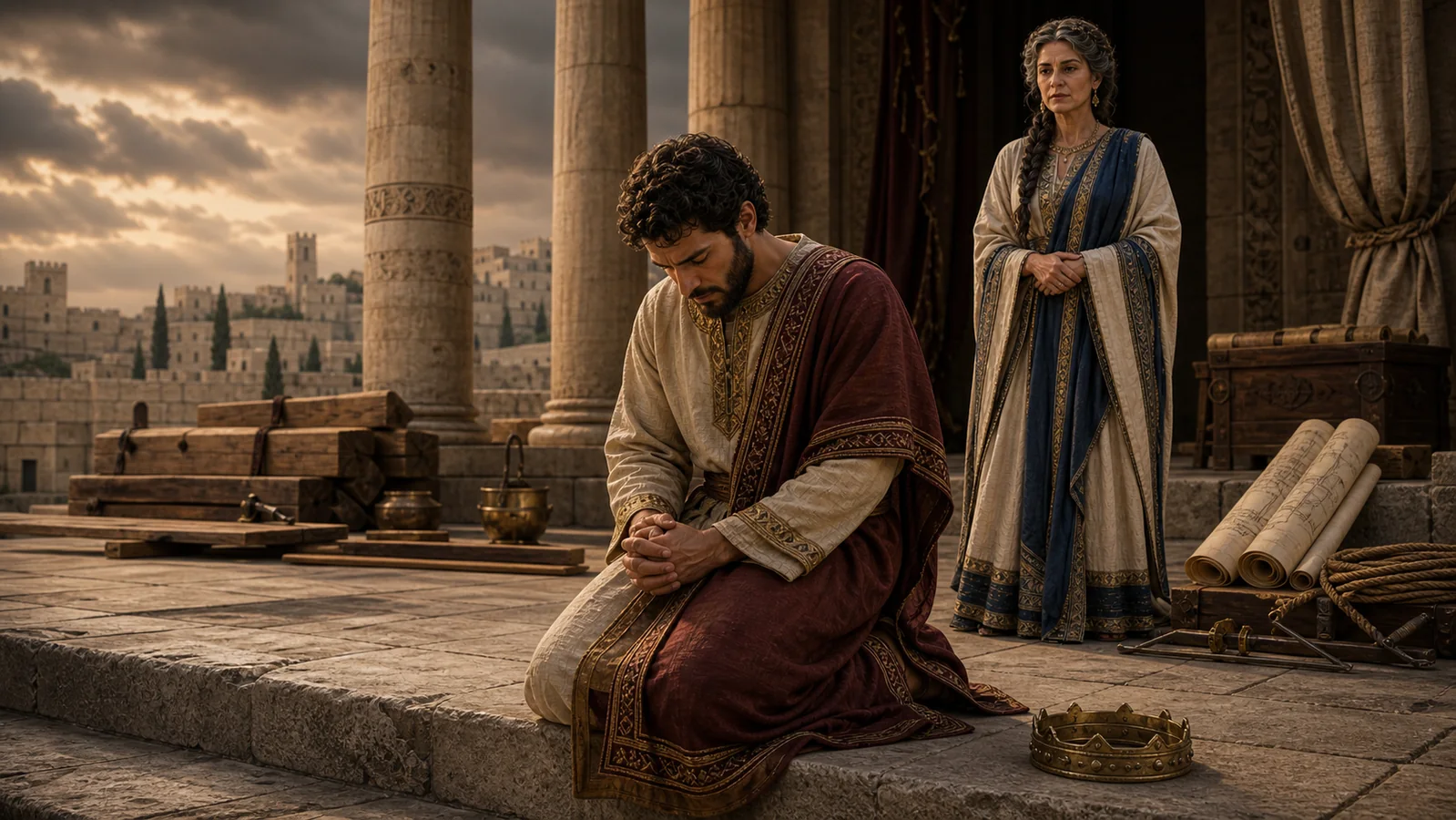
Bathsheba’s later years are not narrated in detail. Scripture does not tell us how long she lived into Solomon’s reign, how often he sought her counsel, or whether she saw the temple completed. It would be moving to picture her studying its plans or watching its stones rise, but those scenes would be imaginative reconstruction, not biblical report.
What Scripture does show is substantial. Bathsheba, daughter of Eliam and widow of Uriah, endured the consequences of David’s sin and the death of her first child. She later bore Solomon, whom the Lord loved. When David’s final weakness created an opening for Adonijah, Bathsheba acted on Nathan’s counsel, appealed to David’s oath, and helped bring the concealed struggle into the king’s presence. David responded by publicly establishing Solomon, and Bathsheba later received visible honor at her son’s right hand.
Solomon began his reign with a kingdom wounded by years of conflict. Amnon was dead. Absalom was dead. Adonijah was dead. Joab’s long service had ended in judgment. Abiathar had been removed, and Shimei would also die. Peace did not emerge because the past had never happened. It came through a costly transition in which sin, ambition, mercy, and judgment were all painfully present.
At Gibeon, the Lord appeared to Solomon in a dream and invited him to ask what he should receive. Solomon confessed his youth and inadequacy and asked for an understanding heart to govern God’s people and discern between good and evil. The Lord was pleased that he had asked for discernment rather than long life, riches, or the death of his enemies. God granted him wisdom and also promised riches and honor, while calling him to walk faithfully as David had walked.
Soon Solomon’s wisdom was displayed in the judgment between two women who each claimed the same living child. All Israel heard of the decision and recognized that the wisdom of God was in him to administer justice.
The name Solomon is connected with peace, and his reign opened with a measure of rest David had seldom known. Yet Scripture never treats the promise as permission for presumption. David’s final charge placed obedience at the center. The same king who was given wisdom would still be responsible to love the Lord, keep His covenant, and refuse the idolatry that power and foreign alliances could bring.
Bathsheba’s story should therefore end neither in romantic triumph nor in unrelieved shame. The biblical account is more truthful than either. David sinned grievously against her and Uriah. The Lord exposed and judged that sin. The royal house suffered violence that human neglect and ambition intensified. Yet God did not abandon His covenant purpose. Solomon, the second son born to David and Bathsheba named in this account, sat on the throne by the Lord’s providence and David’s sworn decree.
Generations later, the Gospel of Matthew would include this broken history in the genealogy of Jesus Christ. Bathsheba is identified there not by name but as “the wife of Uriah,” preserving the memory of David’s guilt even while tracing the royal line through Solomon. Grace does not rename evil as good or erase the wrong done to the vulnerable. It tells the truth about sin and still accomplishes God’s redemptive purpose.
So the closing image is not one Scripture directly paints, but one its testimony allows us to understand: Bathsheba had moved from a place of profound loss into a place of royal honor, not because the road had been clean or easy, and not because every wound had disappeared. Her son sat on David’s throne. The kingdom stood. The work of building the temple lay ahead. Above every human scheme remained the Lord, faithful to His word and sovereign even through a family’s shattered history.
Bathsheba’s chapter closes with both promise and warning. God’s purposes held, but every king still had to walk in His ways. Solomon had received the crown. Now he had to learn to carry it.