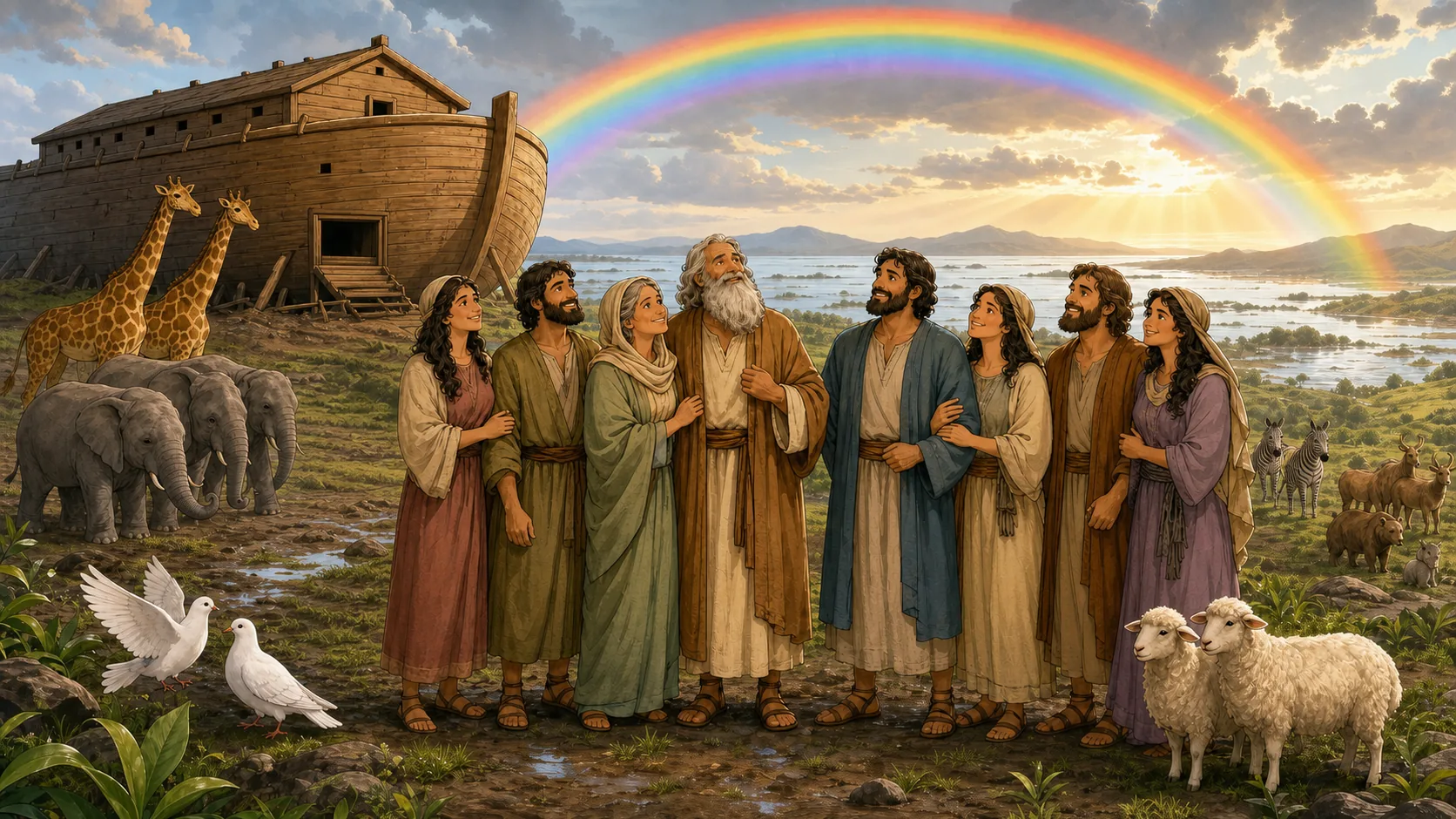
Primary passage: Genesis 7–9
Estimated time: 20–30 minutes
Suggested rhythm: Read Scripture 10–15 minutes; study the notes 5–7 minutes; answer the questions 5–8 minutes; pray for about 1 minute.
Study rule: Read the assigned Scripture before these notes. Scripture is the authority; summaries, connections, and applications below are study helps.
1. Read
Read Genesis 7–9. Track who enters the ark, the rise and fall of the waters, God’s remembrance of Noah, Noah’s worship, and every group included in the covenant.
2. Plain-language summary
Flood: Noah enters the ark with his wife, his three sons, their wives, and the animals God appoints. The flood covers the land and destroys life outside the ark.
Rescue: God remembers Noah, sends a wind, and causes the waters to go down. After leaving the ark, Noah worships.
Covenant: God blesses the family, repeats the call to multiply, and protects human life because people bear God’s image. He permits animal food while forbidding blood consumption and murder. God makes a covenant with Noah, his descendants, and every living creature. The rainbow is its sign.
Later failure: The chapter closes honestly with Noah becoming drunk, family dishonor, and consequences involving Canaan.
3. What does this show about God?
- God judges evil and preserves Noah, his family, and the creatures in the ark.
- God remembers—not because he forgot, but because he acts faithfully for those under his care.
- God receives Noah’s worship and gives creation an ongoing order.
- God values human life because humanity still bears his image after the fall.
- God’s covenant mercy extends to Noah’s descendants and every living creature.
4. Command, promise, warning, covenant
| Category | Observation | Reference |
|---|---|---|
| Command | Humanity must multiply, and blood must not be eaten. God demands an accounting for the shedding of human blood because humanity bears God’s image. This does not authorize private revenge. | Genesis 9:1–7; Romans 12:19; 13:1–4 |
| Promise | God promises never again to destroy all flesh by a flood and promises continuing seasons while the earth remains. | Genesis 8:21–22; 9:8–17 |
| Warning | Judgment is deadly; intoxication and dishonor also bring shame and family damage after the flood. | Genesis 7; 9:20–27 |
| Covenant | God establishes a covenant with Noah, his descendants, and all living creatures; the rainbow is the sign. | Genesis 9:8–17 |
5. Important correction
Genesis 9 does not teach that any modern race or skin color is cursed. The spoken judgment names Canaan, not an ethnic “race,” and later racist uses of this text are false and harmful. All humans share the image-bearing dignity stated again in Genesis 9:6.
6. Connect to Christ and the New Testament
- Explicit New Testament connection: Jesus compares the sudden arrival of final judgment to the days of Noah (Matthew 24:37–39).
- Explicit New Testament connection: First Peter 3:20–22 uses Noah’s deliverance as a pattern connected with baptism and grounds salvation in Jesus Christ’s resurrection and reign.
- Canonical contrast: The Noahic covenant preserves the world; the new covenant in Christ deals with sin through his once-for-all sacrifice (Luke 22:20; Hebrews 10:10–18). These covenants should not be collapsed into one another.
7. Vocabulary
- Covenant: A solemn commitment or ordered relationship established by God. Biblical covenants differ in their parties, promises, signs, and obligations.
- Sign: A visible reminder connected to a covenant promise.
- Remember: In covenant language, God’s faithful movement to act for those he has committed to preserve.
- Image of God: Human dignity and accountability grounded in God’s creation of humanity.
- Preservation: Keeping life from destruction.
- Recede: To move back or go down, as the floodwaters did.
- Intoxication: Loss of clear judgment and self-control because of alcohol or another drug.
- Dishonor: Treating someone shamefully or without proper respect.
8. Think and respond
- Who is included in the covenant of Genesis 9?
- Why does Genesis 9:6 treat murder so seriously?
- How does the ending about Noah warn us that the flood did not remove sin from the human heart?
9. Prayer
Faithful God, thank you for remembering your promises and valuing every human life. Keep us from twisting Scripture to harm others. Teach us to receive your mercy with worship, clear judgment, self-control, justice, and trust in Jesus Christ. Amen.