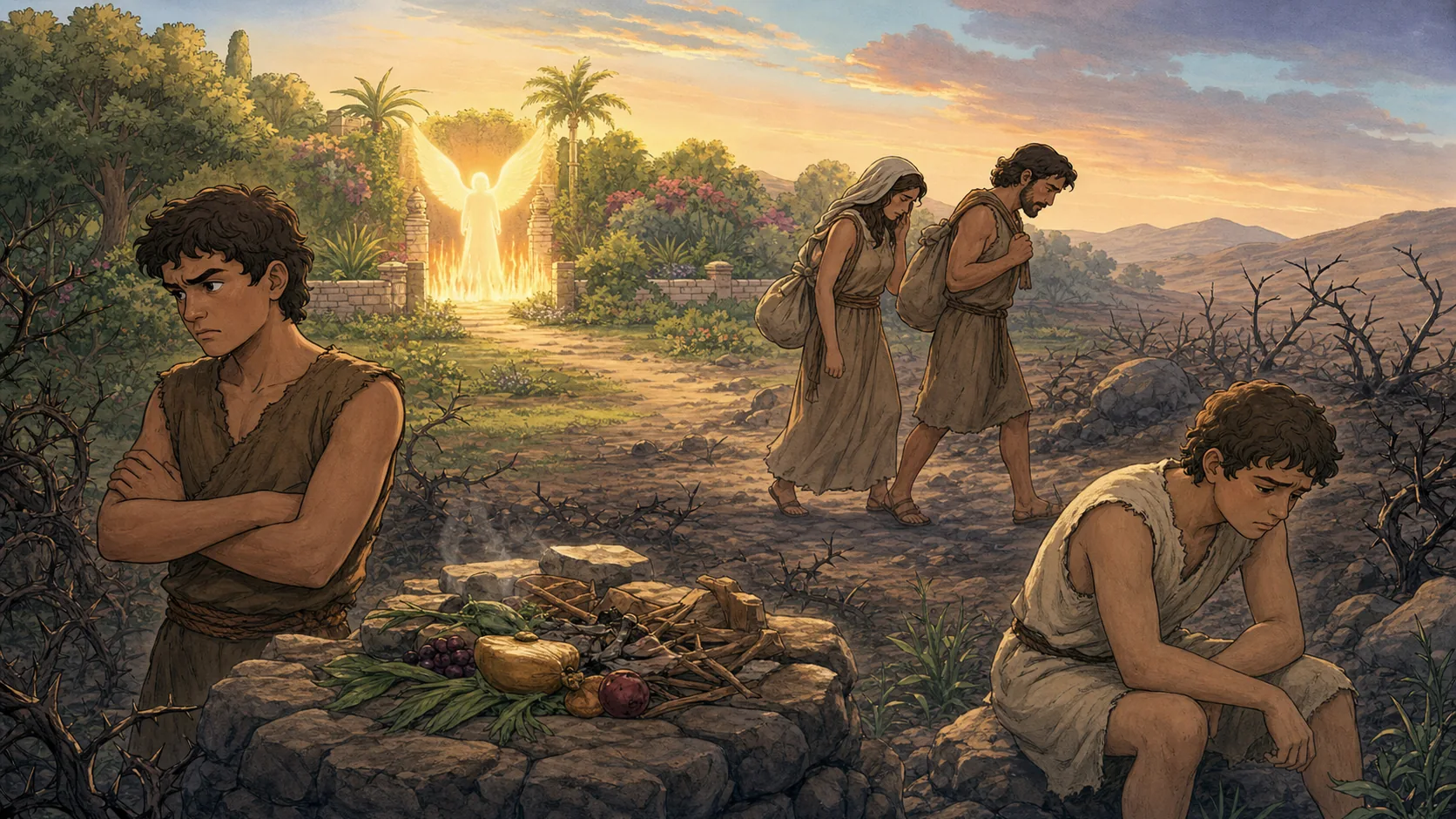
Primary passage: Genesis 3–4
Estimated time: 20–30 minutes
Suggested rhythm: Read Scripture 10–15 minutes; study the notes 5–7 minutes; answer the questions 5–8 minutes; pray for about 1 minute.
Study rule: Read the assigned Scripture before these notes. Scripture is the authority; summaries, connections, and applications below are study helps.
1. Read
Read Genesis 3–4. Track the serpent’s questions, the humans’ choices, God’s questions, the judgments, and the ways God restrains evil even while sin spreads.
2. Plain-language summary
The serpent twists God’s command, and the woman and man eat from the forbidden tree. Shame, fear, blame, pain, conflict, toil, death, and exile follow. God judges the serpent and the humans, yet he also clothes them. He bars access to the tree of life so that humanity will not eat and live forever. Many interpreters understand this exclusion as mercy within judgment, but Genesis does not state that purpose directly. In the next generation, Cain refuses God’s warning, kills Abel, and avoids honest confession. God judges Cain but also places a protective mark on him. Human culture develops, but violence grows with it.
3. What does this show about God?
- God speaks truthfully and holds people responsible.
- God seeks the hiding sinner with questions.
- God’s judgment is real and morally serious.
- God’s mercy appears even in judgment: clothing, protection, and preserved life.
- God warns before Cain acts, showing that anger must not be allowed to rule.
4. Command, promise, warning, covenant
| Category | Observation | Reference |
|---|---|---|
| Command | Cain is told that he must rule over sin rather than surrender to it. | Genesis 4:6–7 |
| Promise | Genesis 3:15 announces conflict between the serpent and the woman’s offspring: the offspring will strike the serpent’s head while the serpent strikes his heel. Christians read this judgment in light of later Scripture as the beginning of a theme that culminates in Christ’s victory. | Genesis 3:15; Romans 16:20; Hebrews 2:14 |
| Warning | Distrusting God’s word and deciding right and wrong apart from God lead to death and exile; uncontrolled anger leads toward violence. | Genesis 3:1–19; 4:6–8 |
| Covenant | No covenant is formally established in Genesis 3–4. | — |
5. Connect to Christ and the New Testament
- Explicit New Testament connection: Romans 5:12–21 contrasts Adam’s trespass, which brings sin and death, with Christ’s obedient work, which brings righteousness and life.
- Explicit New Testament connection: First John 3:12 names Cain as an example of hatred and evil action. Hebrews 11:4 remembers Abel’s faithful offering.
- Christian canonical interpretation: Christians have long read Genesis 3:15 as an early promise pointing toward Christ’s victory over the devil. The verse begins that theme, but later Scripture makes the connection clearer (Romans 16:20; Hebrews 2:14).
6. Vocabulary
- Temptation: Pressure or desire that invites disobedience.
- Sin: Rebellion against God in desire, thought, word, or action.
- Judgment: God’s right response to evil.
- Mercy: Compassion shown to someone in misery or guilt.
- Exile: Being sent away from one’s home or place of blessing.
7. Think and respond
- In Genesis 3:1–5, how does the serpent misrepresent God’s word and character?
- In Genesis 3:8–13 and 4:8–10, where do Adam, Eve, and Cain hide, shift blame, or avoid honest confession?
- What warning signs should you notice before anger controls your actions?
8. Prayer
Holy God, we confess that we often doubt your goodness, hide, and blame others. Give us honest repentance, protect us from hatred, and teach us to trust the victory and mercy you give through Jesus Christ. Amen.